Tell us about your background. Where are you from? What brought you to Mpala? Where have you previously studied or conducted research?
I’m a behavioral ecologist and evolutionary biologist interested in how collective behavior and decision-making emerge in wild social animals. I’m especially curious about how individuals in structured social groups navigate ecological and social challenges—such as how they decide when to move, where to go, and how to coordinate with others.
My work sits at the intersection of field biology, theory, and quantitative analyses. I combine behavioral observations in the wild with high-tech tools like GPS tracking, accelerometry, drone-based habitat mapping, and statistical and theoretical modeling. I’m particularly interested in how group-level behavior is shaped by ecological constraints, internal physiology, and social structure, and how these factors ultimately influence the decisions animals make in a changing world.
Over the past 16+ years, I’ve worked across a wide range of taxa and ecosystems, from butterflies in California to mountain gorillas in Rwanda, chacma baboons in South Africa, capuchins and spider monkeys in Central America, sifaka in Madagascar, and group-living birds in East Africa, Europe, and Australia. Across all of these systems, I’ve been interested in the same core question: how do individual decisions scale up to collective outcomes?
I completed my undergraduate degree in Biological Sciences at Cal Poly, San Luis Obispo and my Master’s and PhD in Evolutionary Anthropology at the University of California, Davis, with additional research at the Max Planck Institute of Animal Behavior in Germany. My doctoral research, based at the Smithsonian Tropical Research Institute in Panama, focused on collective movement and social foraging decisions in wild white-faced capuchins and black-handed spider monkeys living in the tropical rainforest of Barro Colorado Island.
I first came to Mpala in 2018 as a PhD student working with the baboon project, at a time when we were just beginning to explore how biologging tools like GPS collars could be used to study social behavior in the wild. I’m now back as a Postdoctoral Fellow at the University of Zurich, where I develop and test theoretical predictions about how changing environmental conditions shape collective movement and decision-making. My ongoing research focuses on extending optimal foraging theory to social species and testing these ideas in the wild using long-term data from vulturine guineafowl at Mpala.
What projects are you currently working on at Mpala? What are your research goals?
My current project starts with a simple question: do the theories we use to predict animal behavior still hold when the environment changes dramatically?
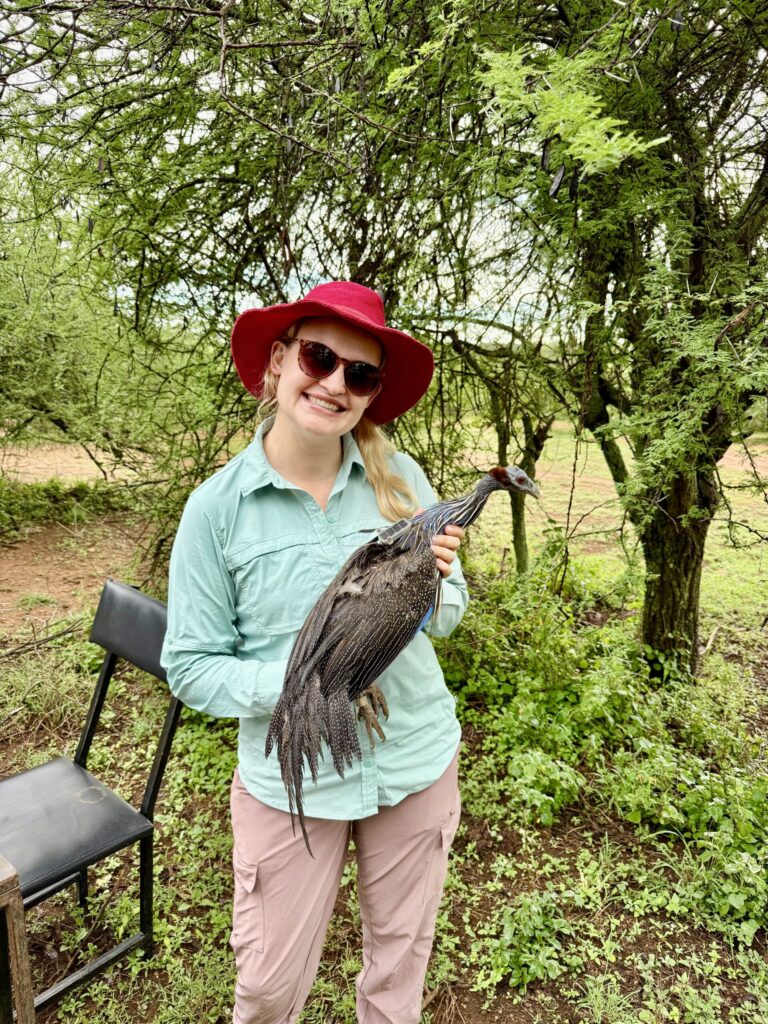
To answer this, I work with the long-term Vulturine Guineafowl Project at Mpala, which has been collecting detailed movement and behavioral data on wild guineafowl groups for more than ten years. What makes this dataset especially powerful is that it spans both relatively favorable conditions and the most extreme drought on record in East Africa from 2020 to 2023. That means I can directly compare how animals behave under very different environmental realities.
Across these ten years, we have deployed small, lightweight backpack tags on the birds that record both their GPS location and fine-scale movement (accelerometer) data throughout the day. These data allow us to track where they go and what they’re doing in remarkable detail. The accelerometers in the tags record movement every second, and we use machine learning models to translate those signals into behavior—essentially allowing us to tell when a bird is foraging, moving, resting, or preening, similar to how a smartwatch can track your daily activity.
From there, I use statistical models to understand how individuals switch between these behaviors over time, and how those patterns change as conditions become more harsh. In simple terms, I’m asking how animals reorganize their daily lives when food becomes scarce and the environment becomes more stressful.
The theoretical backbone of my work is optimal foraging theory, a framework developed over fifty years ago that predicts how animals should balance feeding and movement to maximize energy intake. But these models were largely developed without considering social animals nor extreme environmental conditions. My goal is to test whether these classic ideas still hold, or whether animals adopt new strategies under environmental stress. More broadly, I’m interested in how climate change is reshaping the decision-making processes of animal societies, and whether the theories we’ve built over decades can still help us understand—and even predict—behavior in a rapidly changing world.
What is one of your favorite things about working at Mpala?
One of my favorite things about working at Mpala is the constant exchange of ideas across completely different systems. You might spend breakfast talking to someone working on wasps, lunch with someone studying large mammals, and dinner with someone analyzing long-term changes in plant biodiversity in plots that exclude herbivores. That kind of cross-pollination genuinely shapes how I think about my own work and regularly pushes me in new directions.
Mpala has also given me the chance to work in the same landscape across very different species. I first worked here on baboons and now on vulturine guineafowl, and it’s fascinating to see how differently species use the same environment. That perspective has really broadened how I think about behavior, ecology, and what might (and might not) generalize across systems.
On a more personal level, Mpala has been a place of growth for me. I first came here as a PhD student and now returned as a postdoctoral fellow, and along the way I’ve built wonderful collaborations and friendships.
And then I of course love the everyday experience of being here. You can drive the same road every morning and see something completely different each time—elephants one day, a leopard the next (a black one if you’re lucky!), or just subtle shifts in how animals are moving through the landscape. It’s exhilarating for a field biologist like me!
What impact do you believe your time at Mpala will have on your professional career?
Mpala has already had a major impact on my career. I first worked at Mpala during my PhD, and returning later as a postdoctoral fellow has really brought into focus how much this place has shaped my research.
One of the biggest impacts is how Mpala has expanded the way I think about my work. My research spans very different systems and environments, from tropical rainforest primates to birds (and baboons) in a semi-arid savannah, and working at Mpala has helped me to think more critically about how “generalizable” our ideas are. Working in diverse ecosystems and across species makes you ask whether the patterns you see are specific to one system, or whether they reflect something truly fundamental about how animals behave.
Scientifically, the Vulturine Guineafowl Project at Mpala provides something that is increasingly rare: long-term, high-resolution data that allow us to test fundamental theories in real-world conditions. That has been central to my current work, especially in asking how animals respond to extreme events like drought and whether the frameworks we rely on can still predict behavior under those conditions. These questions feel especially urgent in the context of climate change. As environments become more extreme and less predictable, understanding how animal societies respond—and whether we can anticipate those responses—will be critical for both basic science and conservation. My time at Mpala is directly shaping that line of work and helping me build a research program focused on how environmental change reshapes social behavior and decision-making.
More personally, Mpala has also given me a community of collaborators and close friends, and a place where I’ve been able to grow as a scientist across different stages of my career. I expect it will remain an important part of my research for many years to come.