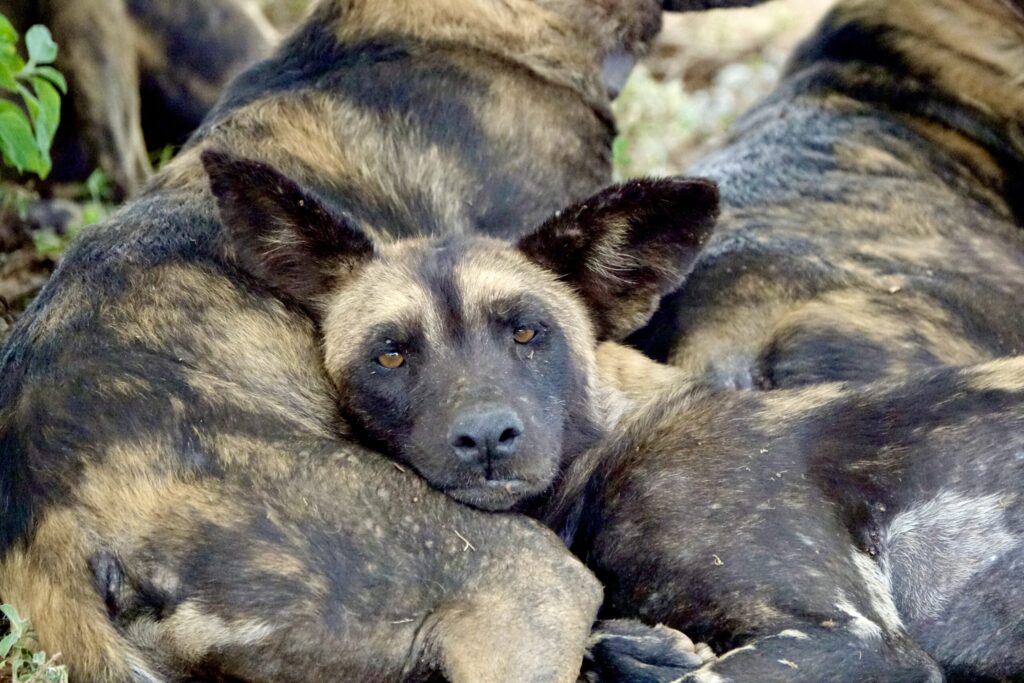
6:00am: Early start. We’re looking for the Phoenix pack. A pack of six wild dogs that spend most of their time within the confines of Mpala. Almost 10 years ago a devastating disease outbreak killed nearly every wild dog across the Laikipia landscape. A female dog (subsequently named Phoenix as she was the one to ‘rise from the ashes’) was the only one to somehow survive. These six dogs are her descendants.
If we find them today, the plan is to put a ‘Daily Diary’ on one of the dogs for the next two months – a very special collar that records movement data 40 times a second. This allows us to identify not only where a dog has been, but exactly what it was doing (resting, running, eating etc.) at any given moment – even when we can’t see it.
6:30am: Our last GPS ping tells us the dogs were only a few kms from camp, but it’s already a few hours old and this is their most active time so it’s little more than a starting point. We head out and get out the radio tracker as we get closer – a large antenna that beeps louder when pointed in the direction the dogs currently are.
7:00am: We have a signal from the tracker which means they’re close! The problem is we’re in a hilly area, the signal is bouncing around and just as strong in multiple directions. They never make life easy.
7:15am: “It looks pretty wet and muddy here, are you sure the car can handle it without getting stuck?”
“Yeah, don’t worry, Land Cruisers can handle everything”.
A word-for-word conversation in the car between myself and my passenger as we turned down what can only very loosely be called a ‘road’.
7:16am: We’re stuck in the mud. Whenever it rains, black cotton soil is the bane of every Laikipia researcher’s existence. Turns out I was wrong about the Land Cruiser – it may be able to handle most things, but definitely not ‘everything’. After some increasingly desperate digging and overly optimistic attempts to use stones and logs to provide grip, we concede defeat and have no choice but to call for assistance. At least the view is good and we have plenty of chai with us.
8:30am: Rescue. Being so close to camp, needing to call for help is mercifully straightforward. In no time we’re continuing our search for the dogs with nothing but a dented sense of pride and very muddy shoes to show for our detour.
9:30am: We have the dogs! We find them just as the heat of the day is forcing them to rest. We’ve missed them hunting, but the silver lining is they won’t move again until at least 5pm. Plenty of time to call the vet, dart one and put the Daily Diary on.
11:00am: The vet arrives and we convene a few hundred metres from the pack to prepare. Darts, drugs, sampling equipment, the collar itself – all of it needs to be prepped and ready to go.
11:15am: Ready. We’ve earmarked a shaded spot nearby to work on the dog while it’s under – cool enough to keep its temperature stable but open enough to give us room to work. We get back in the car and head back towards the pack.
11:20am: We approach the dogs very slowly. Darting requires getting close and one wrong move could spook them and send them running and we could lose our opportunity.
11:25am: We stop about 10-15 metres away. The dogs have barely even acknowledged our presence. The vet raises the dart gun and fires – a perfectly placed shot in the rump of a female. She jumps up, startled, but looks around at the rest of the pack. They’re still completely calm so she takes her cue from them and settles back down. Within a few minutes she’s asleep.
11:30am: We ease out of the car, collect the dog and bring her onto the backseats, laying her across the laps of those sat in the back. It’s a surreal experience having something as deadly (at least to an impala) as a wild dog just asleep on you in a car. A moment you never forget.
11:35am: Back at the rendezvous point we get to work. We have roughly an hour of anaesthetic time – plenty to get everything done but it’s still important to be efficient. I monitor the anaesthetic, checking her pulse and respiration rate periodically, watching for any signs she may be surfacing quicker than expected. Meanwhile we work through the procedure list: blood, hair and parasite samples for genetic and disease testing, fitting the collar, body measurements and ID photos.
Amongst all this an unexpected discovery is made. The dog is not a female. He is in fact what we call a ‘cryptorchid’. Very common in domestic dogs but much more rarely seen in wild dogs, a cryptorchid is a male whose testicles haven’t properly descended out of the abdomen and is, sadly, likely to be infertile.
12:20pm: Time for some quick photos before he wakes up. No matter how many wild dogs you’ve been involved in darting the novelty never fully wears off. The first time I did this was the definition of a pinch me moment. Wild dogs have been my favourite animal my entire life, it’s hard to believe I now get paid to work with them.
12:30pm: An hour after the initial darting, it’s safe to administer the reversal drug. The dog is up and awake (looking only a little drunk) within minutes.
1:00pm: It’s important to stay with him until he fully reunites with his pack. He’ll still be a bit wobbly from the drugs for another couple of hours and a wobbly wild dog on its own is in trouble if he meets a lion or hyena. When the reunion finally happens it’s special. The pack mob him, tails up, twittering, body-slamming and face-licking. You’d think they hadn’t seen each other for months, not hours. These social dynamics are my favourite thing about wild dogs and moments like this will always be a privilege to witness.
2:00pm: Time for a nap and some lunch – it has been a full-on morning.
We can’t just stop for the day though. Having the pack so close to camp is a rare chance to watch them hunt this evening while one of them is wearing the Daily Diary. Being able to see exactly what a behaviour looks like in real life and then match it against the movement signals the collar is recording is how we eventually train computers to recognise those behaviours from the data alone. In a job where most of what the dogs do happens out of sight, opportunities like this are potentially invaluable.
3:30pm: Back to the dogs. We don’t want to leave it too late and risk losing them so we head back out sooner than strictly necessary. There was no need to rush – they’re precisely one bush over from where we left them. They still look full from the morning’s hunt, and we slowly accept that the evening hunt we were hoping for probably isn’t coming. Fortunately we have plenty of cold drinks and the company is good, so we settle in for sundown with the dogs.
7:00pm: They still haven’t moved. As it starts to get dark we sadly have no choice but to leave – whatever they ate this morning was clearly plenty for them for today. It’s a small loss from a data analysis standpoint, but there will be other evenings. And honestly, in my opinion spending 3.5 hours sat with wild dogs (even ones whose most ambitious activity is a bit of grooming and an occasional five step stroll) is just about the perfect way to spend an evening.
8:00pm: Back at camp for dinner and an early night. Tomorrow we go again. It’s been a tiring day but a great one. Right now, only a few kms from camp, a wild dog is wearing a collar that will tell us in complete detail what life in the pack looks like over the next two months. The world is changing, and it’s getting more challenging for wild dogs year by year. Gathering this kind of information about how they’re adapting is vital to inform us how we can best help them. Which, after all, is why we do what we do.
By Dominic Clarke, First-year PhD Student at Zoological Society of London, studying how African wild dogs are adjusting their behaviour and hunting patterns to deal with the effects of climate change
28th of April, 2026