Tell us about your background. Where are you from? What brought you to Mpala? What have been some of your previous roles?
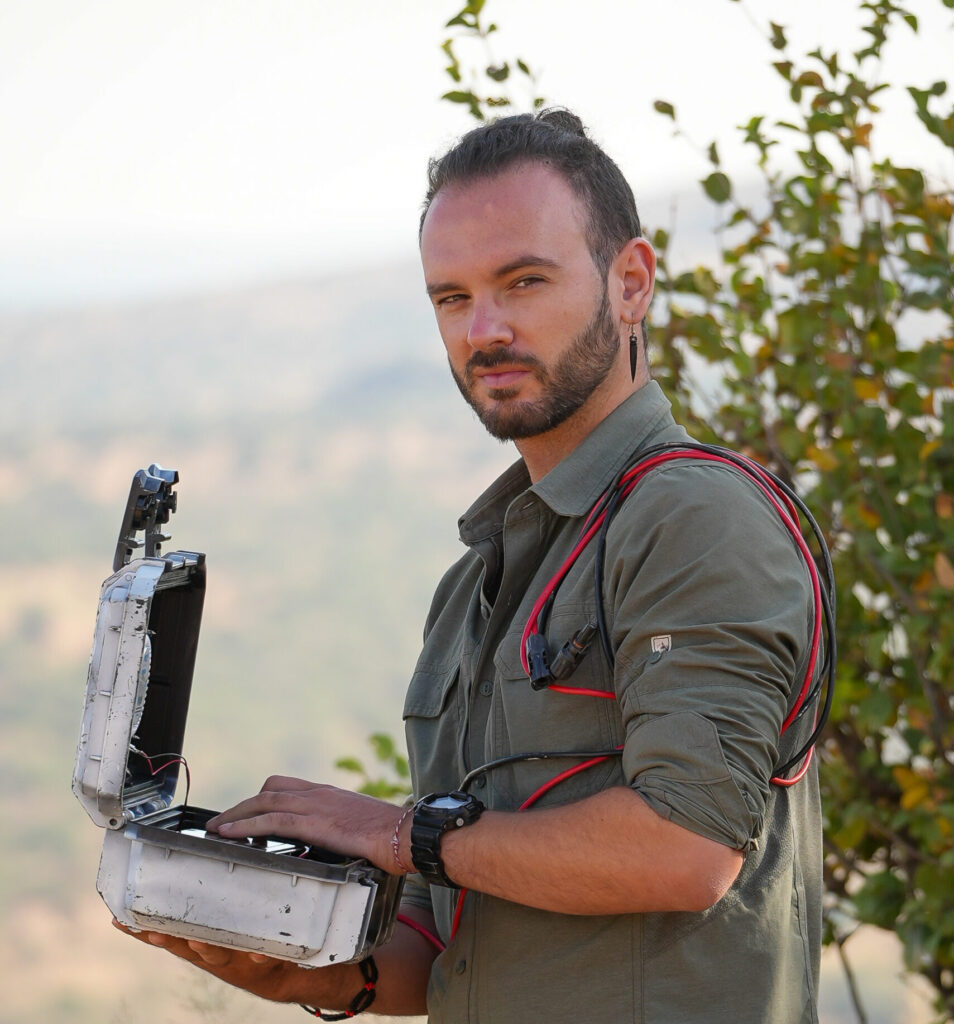
I am a PhD student at the University of California, Santa Cruz conducting research on the ecology of fear and how human disturbance impacts wildlife behavior and energetics. I chose to conduct our playback experiments at Mpala due its legacy of conducting landscape-scale experimental manipulations and its status as a multi-use landscape with a fully intact large carnivore guild. Throughout my career, I have work in research labs, conservation NGOs, government agencies, and tourism operators as a field technician, naturalist guide, environmental educator, conservation scientist, and project manager.
What projects are you currently working on at Mpala? What are your goals?
Currently, we are running the world’s largest playback experiment. We set up 1-km2 grids of playback speakers and expose wildlife to human voices or a control treatment of bird vocalizations. We then measure the impact of those playback treatments on wildlife occupancy, activity levels, and behavior using accelerometer collars, camera traps, and foraging trials. The current experiment is just a pilot to inform the methodology and design of a larger, more comprehensive project – one which we hope will provide novel insight into how human disturbance impacts the behavior and energetics of large carnivores and herbivores that frequently come into conflict with local, rural communities and how this conflict can be deterred with non-lethal means.
What is one of your favourite things about working at Mpala?
I believe the most unique aspect of Mpala is the amount of enthusiasm and engagement in research from every staff department. Whether it is rangers, mechanics, livestock herders, or cooks, everyone significantly contributes to the research in some way, shape, or form – which is not necessarily a common feature of the industry.
What impact do you believe your time at Mpala will have on your professional career?
As one of the most renowned research stations in academic circles, I believe performing these experiments at Mpala will elevate my research profile on the international stage, expand my professional network, and increase the overall impact of research by positioning our findings in front of a larger audience.