Yellow-billed duck

Ducks get their food either by diving or dipping. Yellow-billed ducks are dippers, plunging their heads into the water but not submerging. Dipping ducks—also known as dabbling ducks—are more buoyant than divers.

Yellow-billed Oxpecker

Oxpeckers are commonly seen gobbling ticks from the backs of African mammals. Far from being welcome guests, recent studies view these birds more as vampires that dig into their hosts to reach their preferred food: blood. Most mammals seem to tolerate the wounding as the cost of this pest-control service.

Yellow-necked Spurfowl

Yellow-necked spurfowl, in pairs or in related groups, can be seen strolling along dirt roads, raising dust as they scratch for food. A male will fly to the top of a termite mound and proclaim himself with loud calls.

Yellow-billed Stork

Voracious nestlings eat so much that yellow-billed storks earned the German nickname Nimmersatt—never full.

White-bellied go-away-bird

Adults look alike but you can tell the difference between males and females by the color of their beaks: Males have black beaks, while females have green beaks.

White-browed Robin Chat

White-browed robin chats like to be protected by evergreen shrubs, and make themselves at home in gardens and parks.

White-browed Sparrow Weaver

During breeding season, birds in a flock of white-browed sparrow weavers play different roles. Breeding pairs get assistance from previous offspring, and non-related birds help to defend the breeding territory. They join in the chorus of chirping that warns of approaching predators, with the loudest chirps coming from the breeding pairs.

Vulturine Guineafowl

One quick look at this bird’s bald head and you understand how it got “vulture” in its name. Take a closer look, and you see a spruced-up bird with a neck festooned with long, black-and-white feathers that show a touch of bright blue when ruffled.

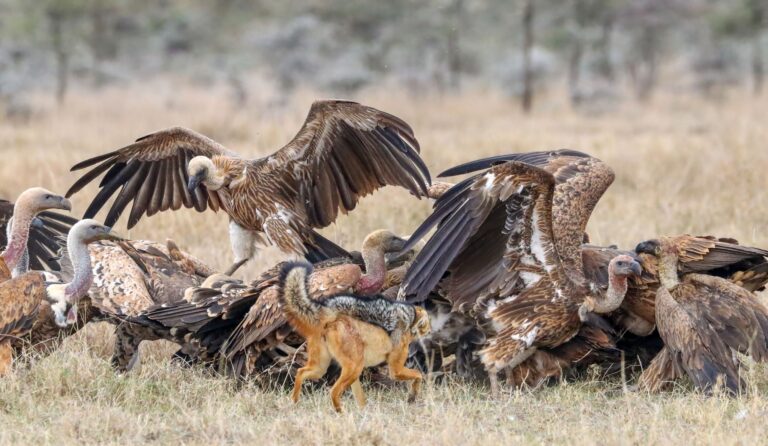
White-backed vulture

Once the commonest and most widespread vulture in Africa, white-backed vultures’ populations have declined more than 80 percent over the past 50 years, and it is now listed as Critically Endangered.

Verreaux’s Eagle

Verreaux’s eagles have an enormous range, but can be seen at only a few scattered sites within it. That’s because the rock hyrax, their preferred prey, lives in isolated communities among rocky niches. The eagles hunt in pairs to seek out this guinea-pig-size animal and stage surprise attacks.