Field Guide
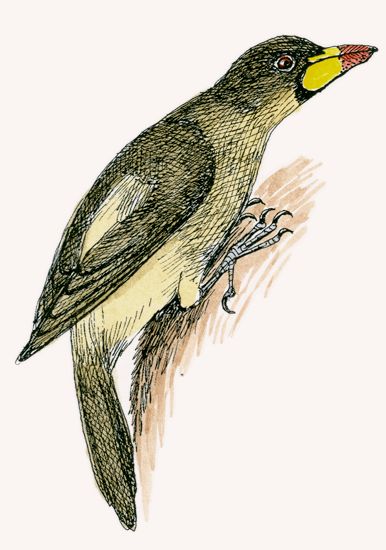
Buphagus africanus
Yellow-billed Oxpecker
Swahili: Shashi domo-njano, Askari wa kifaru


- Type
- Bird
- Daily Rhythm
- Diurnal
- Diet
- Carnivorous
- Conservation Status
- Lower risk
- Size
- 8 in (20 cm) long
Oxpeckers are commonly seen gobbling ticks from the backs of African mammals. Far from being welcome guests, recent studies view these birds more as vampires that dig into their hosts to reach their preferred food: blood. Most mammals seem to tolerate the wounding as the cost of this pest-control service.
The call of the yellow-billed oxpecker is a crackling kriss, kriss.
Yellow-bills nest in tree holes that they line with hair plucked from their hosts. Yellow-bills that are not breeding will spend the night roosting on the mammal that provided their meal.
The International Union for Conservation of Nature (IUCN) lists the status of the yellow-billed oxpecker as “lower risk.” However, its populations are declining primarily due to a reduction in the number of large game animals and the increased use of anti-tick cattle dips containing arsenic.
The yellow-billed oxpecker eats ticks, larvae, and blood.
Yellow-billed oxpeckers nest in tree holes lined with hair plucked from their hosts. Females usually lay two or three eggs.
The yellow-billed oxpecker’s range overlaps that of the red-billed oxpecker. When both species feed on the same group of host animals, the yellow-bill is usually dominant.
Yellow-billed oxpeckers are found in western Kenya and throughout the savanna of sub-Saharan Africa.
Yellow-billed oxpeckers live in small flocks and can be found at sea-level or in mountains as high as 9,800 feet (3,000 m).