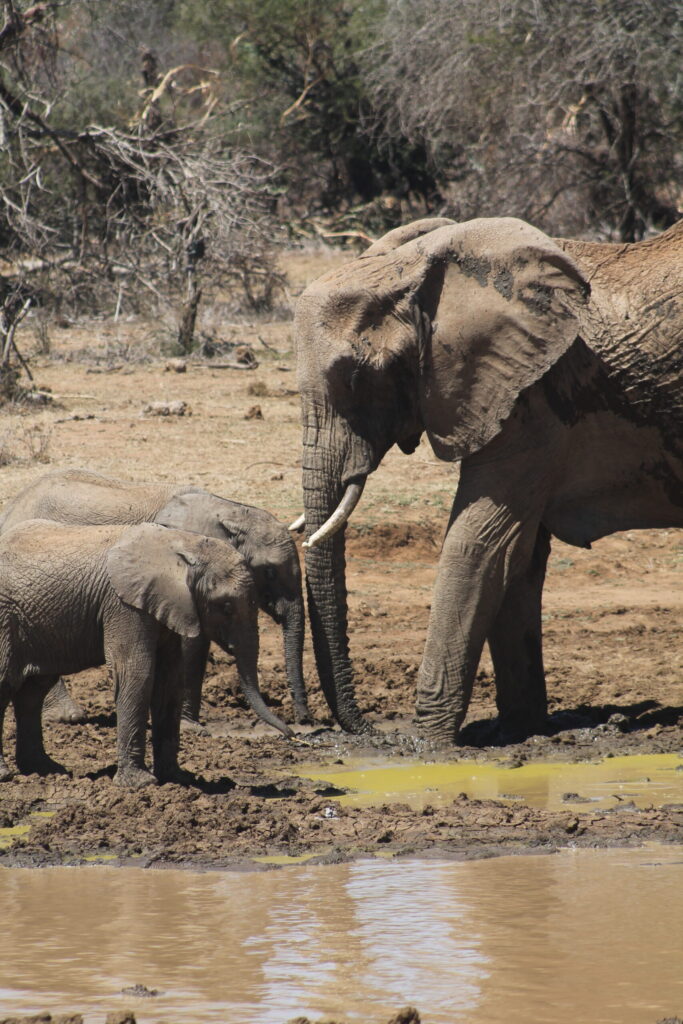
Researchers at Mpala are investigating how elephants communicate via seismic vibrations. Read more about the study and potential outcomes below.
Remarkably, one method through which elephants communicate is via ground-based, or seismic vibrations. We know that elephants generate, and respond to, mini-earthquakes to transfer information between each other using vocalisations known as ‘rumbles’ that concurrently generate an acoustic vibration. Yet evidence for the biological role of these enigmatic seismic signals in the natural environment is lacking. Investigating their biological role is important for understanding how Endangered elephants might be affected by changes in land-use, including increasing anthropogenic seismic noise due to infrastructure development.
Our key research question is ‘why do elephants use seismic communication?’ To answer this, we use two approaches. Firstly we will eavesdrop on the seismic and acoustic signals generated by elephant rumbles. This has involved placing >1200 seismic sensors, >50 acoustic sensors and 30 camera traps in a dense sensor array within Mpala Research Centre. These sensors take a lot of attention, and our team of Dr. Dan Hending, Mr. Tom Mulder and Mr. Samuel Kiuna are present at Mpala throughout the 4-month planned sensor deployment. Continuous recording from these sensors allows us to understand how information content within elephant rumbles changes as it moves through the environment.
Our second approach records the social and behavioural context in which elephant rumbles are generated. This allows us to link properties of the sensor recordings to the context in which they were generated. Whether the elephants are communicating ‘let’s go’ or ‘beware’, this contextual data allows us to link potential information content of the elephant rumbles to the properties of the acoustic and seismic recordings.
The outputs from this study will be evidence of the biological role of seismic vibrations for elephants in their natural environment. These insights are important to inform decisions about elephant conservation and management in natural and captive contexts, including the challenges imposed on elephants due to anthropogenic noise. Through this study, we will also develop novel methods to monitor elephants remotely in real-time by eavesdropping on their rumble vocalisations, which can be used in the future to aid with elephant conservation.
This project is funded by the Natural Environment Research Council, UK. Dr. Beth Mortimer leads the project, with Prof. Tarje Nissen-Meyer and Prof. Andrew Markham as co-investigators. Save the Elephants is a project partner and we collaborate with Mr Sandy Oduor at Mpala Research Centre. We thank the assistance of the rangers during deployment, keeping us safe, and the equipment secure whilst in the field. We thank several people for their generous support with sensor deployment: Prof. Martin Mai, Dr. Laura Parisi, Ms. Mary Karanja and Ms. Sophy Kipkony. Thanks to Ms. Amy Barnes for work on elephant observations and sensor deployment. On-the-ground support and logistics from Mpala has been key to the project running smoothly.
Related
Meet Our Researchers: James Koech
Tell us about your background. Where are you from? What brought you to Mpala? Where have you previously studied or conducted research? I studied at Egerton University, where I earned a bachelor’s degree in economics and mathematics. My passion for applying statistics in research brought me to Mpala Research Centre, which…
Meet Our Researchers: Eunitah Makokha
Tell us about your background. I am Eunitah Makokha from Kakamega County, specifically Lugari Constituency. Growing up, I developed a strong passion for wildlife and research, which led me to pursue a Bachelor of Science in Wildlife Conservation & Management at the University of Eldoret. After graduation, I had the…
Cutting Edge Conversations:
Virtual Panel on Research at Mpala Join us for a discussion of exciting new research published in Nature Sustainability on how elephants can reverse soil depletion caused by cattle. Panelists will not only discuss the implication of these critical findings for sustainability, but will also touch on their approach to…