Project description
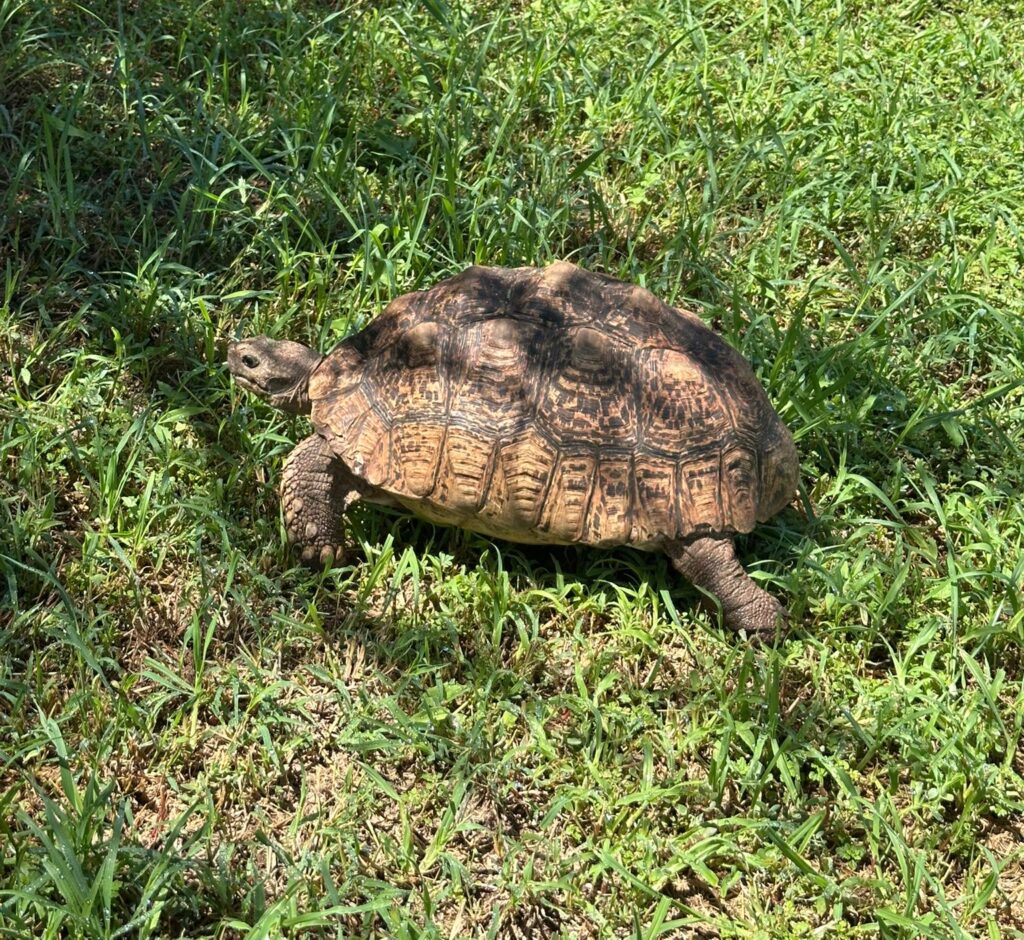
Leopard tortoises (Stigmochelys pardalis) remain poorly studied across Laikipia, representing a knowledge gap in East African reptile ecology. This project will establish the first long-term, individual-based monitoring system for the species in the region, combining community reporting, AI-assisted photo identification, and GPS telemetry to assess population ecology, movement, and conservation status.
Aims
To establish a robust, long-term evidence base for leopard tortoise conservation and management in Laikipia, delivering population estimates, an understanding of movement ecology, disease risk assessment, and mapping of human-wildlife interactions across a staged research framework.
Research objectives
Stage 1 (years 1-3): Tortoise abundance, distribution, and habitat use
• Estimate population size and density using photo-ID mark-recapture methods
• Map tortoise distribution and habitat use across Mpala
• Establish individual home ranges and seasonal movement using GPS telemetry
Stage 2 (years 2-4): Tortoise population dynamics, landscape use, and threats
• Estimate survival, recruitment, and long-term population trends
• Assess landscape connectivity within and beyond Mpala
• Quantify tick burden and screen for pathogens relevant to wildlife, livestock, and human health
• Map home ranges against roads, livestock, land use, and climate variables
Stage 3 (year 4+): Scaling up tortoise monitoring across Laikipia
• Embed community-led monitoring at Mpala and surrounding properties
• Produce annual population reports for managers and landowners
• Engage regional and national conservation policy
Team
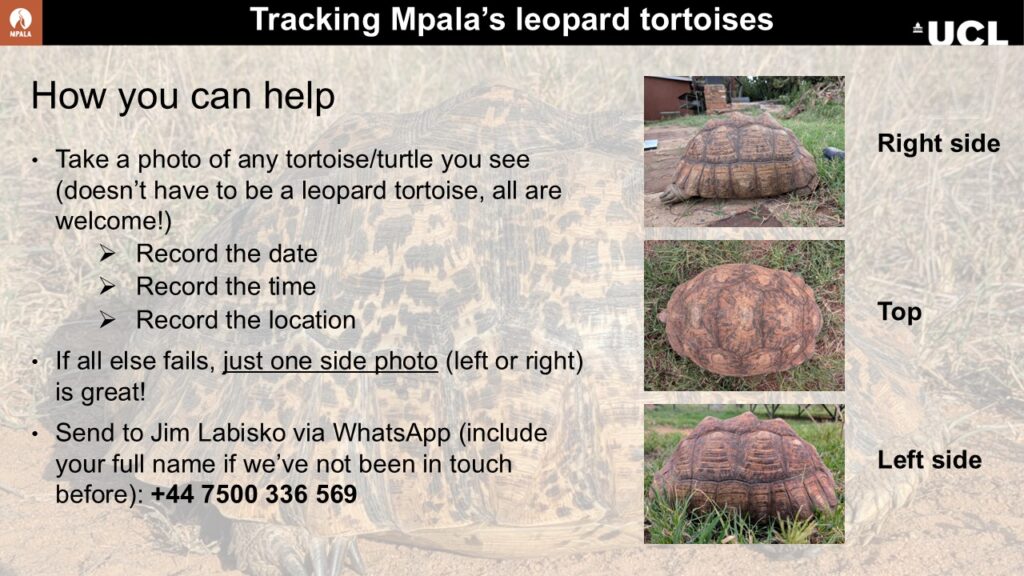
The project is led by Dr Jim Labisko (University College London) in partnership with Mpala Research Centre. Data collection is supported by a growing network of contributors including Mpala staff and field researchers, visiting scientists and students, and community members across the Laikipia landscape. A WhatsApp tortoise reporting network has already proven highly effective, generating observations and fostering engagement across Mpala.
Progress and outputs
Since June 2025, the project has recorded over 400 photographs from 103 observations at 80 locations, including several beyond Mpala. Individual identification is being implemented via Wildbook’s Internet of Turtles platform using the MiewID deep learning algorithm—a non-invasive, scalable approach applied for the first time to tortoises in this region.
Outputs will include population estimates and annual monitoring reports for conservation managers, assessments of disease risk relevant to wildlife and livestock, and a replicable framework for community-based reptile monitoring across Laikipia and East Africa.