Field Guide
Buphagus erythrorhynchus
Red-billed Oxpecker
Swahili: Shashi domo-jekundu, Askari wa kifaru


- Type
- Bird
- Daily Rhythm
- Diurnal
- Diet
- Carnivorous
- Life Span
- 15 years, maximum
- Conservation Status
- Lower risk
- Size
- 8 inches (20 cm) long

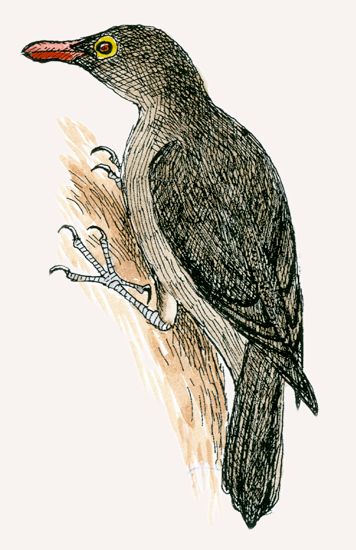
Spot a herd of grazing animals almost anywhere in sub-Saharan Africa and you will see red- and yellow-billed oxpeckers riding on their backs. The birds seem to enjoy the blood they draw as much as the ticks they eat. Although they help rid grazers of parasites, they also open wounds to infection. The birds may provide a clearer benefit: the loud warning hiss they give when predators are near.
Red-billed oxpeckers perch on large wild animals and domesticated cattle. The red-bill devotes its day to plucking insects and ticks from its hosts and—except in breeding season—may also spend the night there.
Red-bills live on what they find to eat on the backs and heads of host animals, especially grazing mammals. They mostly consume ticks and other parasites as well as blood.
The red-bill’s range overlaps that of the yellow-billed oxpecker, which is usually dominant when both species feed together.
In Kenya, red-bills are found mostly in the southwest wherever there are large animals. The red-bill’s range overlaps with the yellow-billed oxpecker. Both varieties can be seen on the elephants, giraffes, hippos, and other large mammals at Mpala’s hippo pool.
The red-billed oxpecker is native to the savanna of sub-Saharan Africa, from the Central African Republic east to Sudan and south to northern and eastern South Africa.