Field Guide
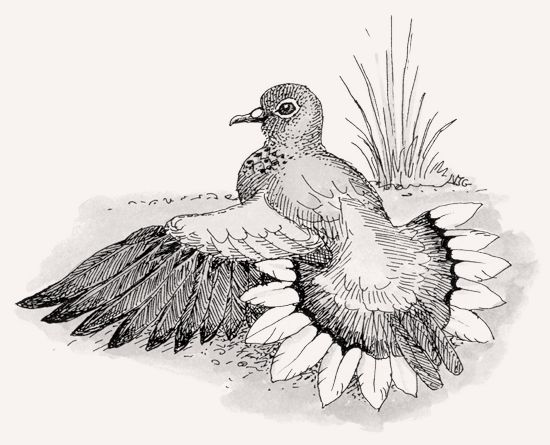
Streptopelia senegalensis
Laughing Dove
Swahili: Hua


- Type
- Bird
- Daily Rhythm
- Diurnal
- Diet
- Omnivorous
- Conservation Status
- Lower risk
- Size
- 9.8 in (25 cm) long

The “voice of the turtle” in the Bible’s Song of Solomon, refers not to a reptile, but to a bird—the turtle dove, which is another name for the laughing dove. The word “turtle” comes from an ancient word that means “murmuring or cooing like a dove.”
Laughing doves are monogamous and usually are seen alone or in pairs. But flocks may form at watering spots or when the doves are feeding on the ground.
The laughing dove’s name derives from its call: ha ha hoo hoo hoo hoo hoo.
Laughing doves sometimes prefer village life, making nests on windowsills or in flower pots.
Laughing doves forage on the ground for seeds and other vegetable matter such as fruit, although sometimes they will pluck fruit while perched. These doves also hunt insects, especially termites.
The male laughing dove collects twigs for a nest, and the female builds it, usually in a fruit tree. It can have as many as 140 intricately intertwined twigs. The female typically lays two eggs at a time, for a total of 10 to 16 eggs during the breeding seasons in spring or fall. Both parents take turns incubating the eggs for as long as two weeks. The chicks are fed “pigeon milk,” a secretion from the adult doves’ crops.
The African mourning dove inhabits much of Kenya, especially in areas of drier bush or trees near water. It is scarce in the highlands and rarely seen on the coast.
The laughing dove inhabits sub-Saharan Africa as well as Afghanistan, Pakistan, India, Saudi Arabia, and Iran and has been introduced to several other Middle Eastern countries. It has even found its way to western Australia, probably by hitching a ride on ships.