Field Guide
Estrilda astrild
Common Waxbill
Swahili: Mshigi kawaida


- Type
- Bird
- Daily Rhythm
- Diurnal
- Diet
- Omnivorous
- Weight
- 5-11 g
- Size
- Length: 9.5-13cm Wingspan: around 12 cm

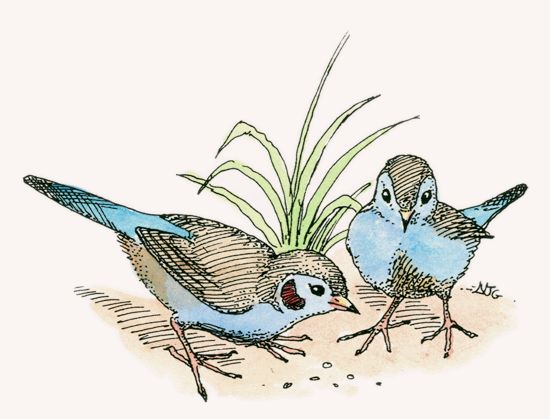
Common waxbills, native to Africa, have become popular pets, and they are now established in fields and forests of the Caribbean, South America, Europe, and as far away as Hawaii.
Social birds that are active during the day, common waxbills forage in groups that can contain hundreds of birds, and will groom each other, a behavior called allopreening.
Common waxbills have a distinctive flight call and several other buzzes and tweets, one of which sounds like “ti-cket please!”
Common waxbills “curtsy” to each other. They perch on grass stems while eating seeds, and also stay on the ground and step on stems to make feeding easier.
Least concern
Common waxbills primarily eat grass seeds, but will boost their protein intake with ants, termites, and moths, especially when breeding. They also need to drink water, since their seed diets do not provide much moisture.
In Kenya, monogamous pairs will sometimes produce two or three broods every year. Nesting in grass clumps or tangled vegetation, they construct a large hollow ball with an added “cock’s nest” on top where the male sleeps. Both parents incubate their eggs and raise the chicks, which are independent around a month after they hatch.
Similar to other finches, common waxbills have predators that include birds of prey, mammals, and snakes. Pin-tailed whydahs lay their eggs in common waxbill nests so that the waxbills raise the chicks as their own.
Common waxbills are particularly numerous around Lake Victoria. Around 17 subspecies of common waxbills can be found throughout much of sub-Saharan Africa.
These birds are found throughout much of Africa, South America, the Caribbean, and elsewhere.