Field Guide
Heterohyrax brucei
Bush Hyrax
Swahili: Pimbi


- Type
- Mammal
- Daily Rhythm
- Diurnal
- Diet
- Herbivorous
- Life Span
- 11 years
- Conservation Status
- Lower risk
- Weight
- 2.9 to 7.9 lb (1.3 to 3.6 kg)
- Size
- 12.6 to 22.0 in (32 to 56 cm) long, excluding tail

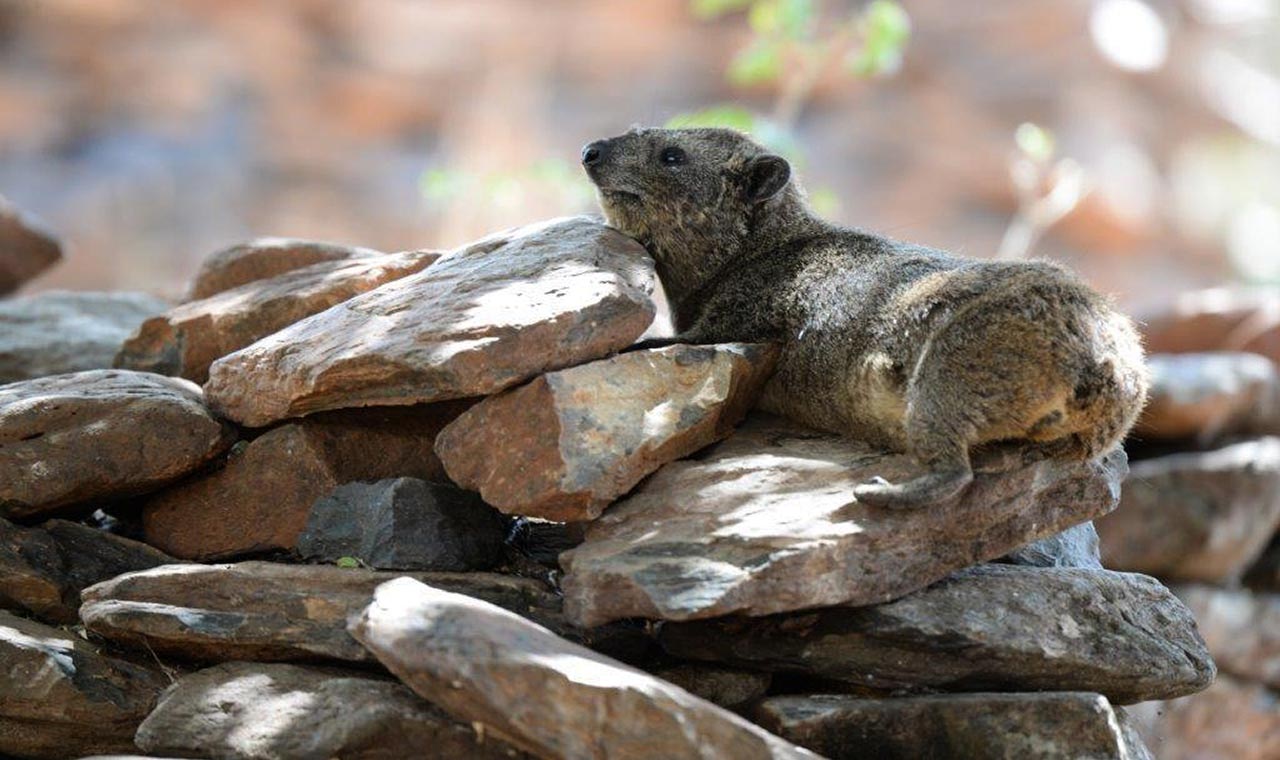
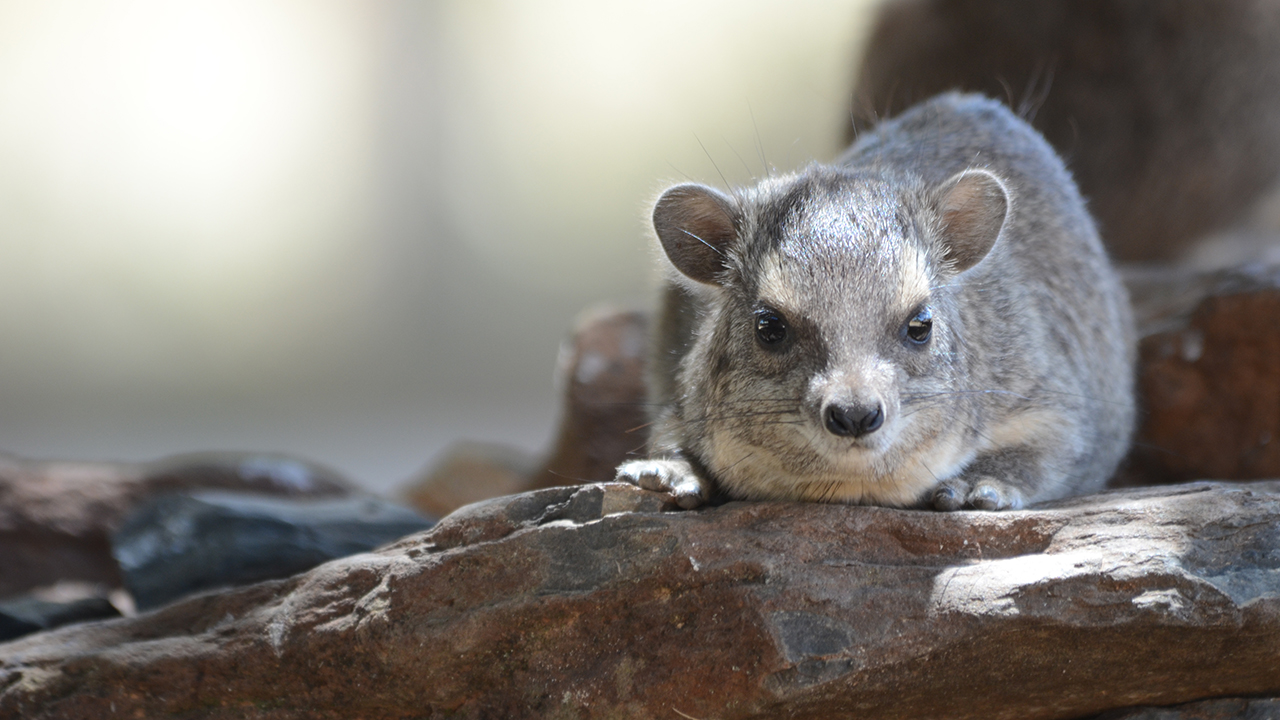
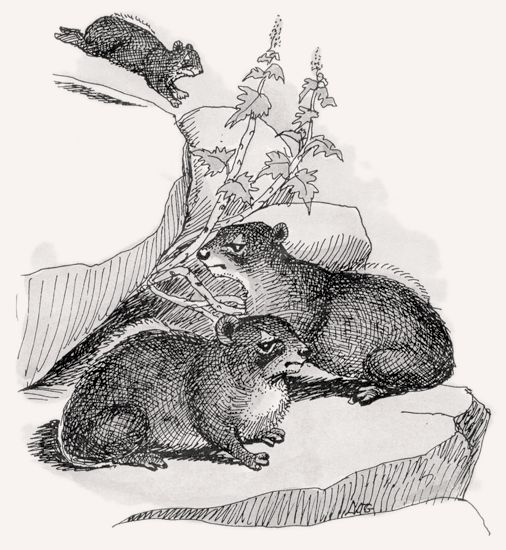
Despite their small size, hyraxes are most closely related to elephants! They share a number of characteristics, such as hoof-like toenails, tusks, and skull structure. Hyraxes also have very specialized feet. The thick, rubbery, padded soles give hyraxes an extremely strong grip—perfect for climbing. Indeed, they are extremely agile creatures, capable of darting from the base of a boulder to the top of a tree in the blink of an eye. Both the bush and the rock hyrax (Procavia capensis) live at Mpala.
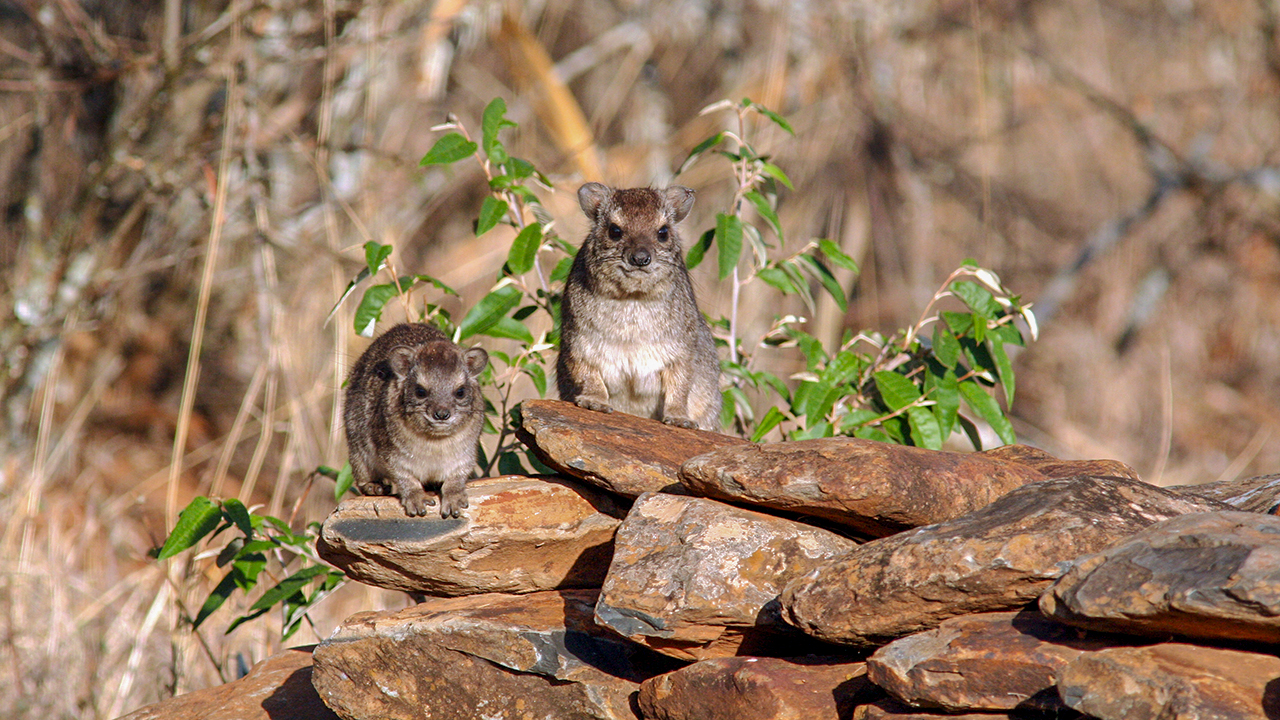
Bush hyraxes reside in a polygamous harem composed of one territorial male, numerous adult females, and juveniles. A harem can have as many as 34 individuals. Female bush hyraxes join this group once they reach sexual maturity (at approximately 16 months), while male hyraxes leave the harem between the age of 12 and 30 months. Some females also leave, likely to prevent inbreeding. Rock hyraxes live in colonies, or large family groups, that can include up to 80 individuals. Each colony has a single adult territorial male, adult females, and juveniles. Male rock hyraxes live solitary lives, and only the top male has the ability to take over a colony if the resident territorial male has been displaced. Bush and rock hyraxes are known to live together and even share burrows, but they do not interbreed.
Big in voice but small in stature, the rock hyrax has at least 21 different calls—from grunts and growls to squeals and snorts—that it uses to communicate within its colony. The bush hyrax also has a set of specific cries it uses to warn of threats or the need to defend territory.
Although diurnal, over 90 percent of their day is spent resting. Hyraxes have very poor internal temperature regulation, so they engage in an activity known as heaping, where individuals huddle, or stack, together in order to conserve heat and regulate their body temperature. Bush hyraxes feed alone and in groups, usually staying very close to their dens; rock hyraxes eat in groups and post sentries to watch for predators.
Although hyraxes are hunted in some parts of Africa for their pelts and meat, their populations are considered to be at no immediate risk.
Although all hyraxes are herbivores, their diets are distinctly different. Bush hyraxes enjoy foraging for twigs, buds, flowers, and fruits and are dubbed “browsers.” Rock hyraxes are much more adaptable. Although they eat mostly grass and are considered grazers, they also feed on other plants.
Although bush and rock hyraxes can inhabit the same area, they have extremely different mating behaviors and reproductive structures that prevent them from interbreeding. Rock hyraxes have a single breeding season, during which the extremely aggressive territorial males dominate all fertile females; bush hyraxes have two birthing seasons. Both species have a gestation period of approximately 30 weeks. Female rock hyraxes can give birth to as many as four pups, whereas bush hyraxes have one or two. Both species synchronize births within their groups. Mothers nurse their own young, but beyond that, the extent of their parental care is limited. Instead, young hyraxes join nursery groups, where they interact with other juvenile rock or bush hyraxes.
The single largest danger for both bush and rock hyraxes is the Verreaux’s eagle. More than 90 percent of its diet is composed of these hyraxes. Some scientists believe that the umbraculum, an eye shield that allows hyraxes to stare at the sun, evolved to help them avoid this particular predator.
Both the bush and the rock hyrax (Procavia capensis) are widely distributed throughout Africa, though in rather patchy populations. The bush hyrax inhabits the regions from Sudan and Eritrea through the Horn of Africa, while the rock hyrax is found as far north as Algeria and Libya and even into the Middle East.
These two species enjoy burrowing into small nooks and crannies on rocky hills or in piles of boulders. Bush hyraxes prefer rocky areas or the dry savanna, whereas rock hyraxes can inhabit regions as diverse as arid desert and rain forest.
Both the bush and the rock hyrax are found in Kenya—including at Mpala—and throughout Africa. The rock hyrax is also found in the Middle East.