Field Guide
Black-and-White Colobus
Colobus guereza Swahili: Mbega mweupe kaskazi


- Type
- Mammal
- Daily Rhythm
- Diurnal
- Diet
- Herbivorous
- Life Span
- In the wild: Insufficient data In captivity: 23 years, 9 months (maximum)
- Conservation Status
- Lower risk
- Weight
- Male: 15 to 32 lb (6.8 to 14.4 kg) Female: 12 to 24 lb (5.4 to 10.9 kg)
- Size
- Male: 21 to 28 in (54.3 to 69.9 cm) long, excluding tail Female: 21 to 26 in (52.1 to 67.3 cm) long, excluding tail
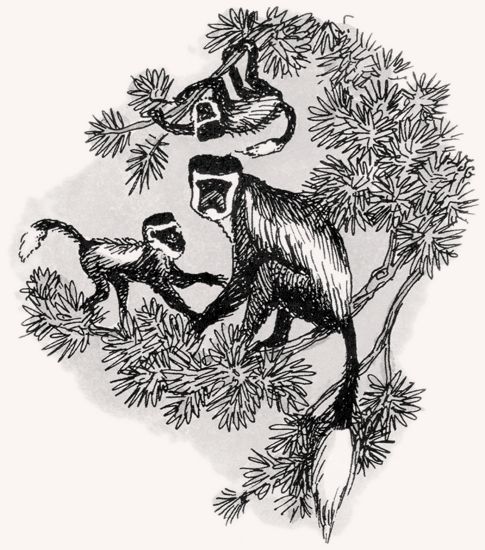
Black-and-white colobus monkeys—like all colobus monkeys—have thumbs that are little more than stubs. These primates are easily recognized by their white-rimmed black faces, white-tipped tails, and the U-shaped “cape” of white hair that outlines their black backs. Quite the acrobats, they can jump as far as 50 feet (12 m).
Social groups normally range in size from 2 to 23 individuals that defend a well-defined territory. Typical groups include one or two adult males, one to six adult females, and their dependent young. However there are also groups of one to four males. Females will sometimes transfer to other groups, while all males leave their birth group, as there can be only one dominant male per group.
The male’s “roar” can be heard up to a mile (1.6 km) away. Around dawn, one roar is usually followed by the roars of other males throughout a forest habitat. Scientists believe these contagious roars notify groups about the presence and proximity of neighboring colobus monkeys.
Black-and-white colobus monkeys live a very sedentary lifestyle, shaped by their need to digest a fiber-heavy diet. They alternate between long feeding and resting periods throughout the afternoon. They spend about 15 percent of their day grooming, with adult females doing most of the work.
Traditionally, black-and-white colobus pelts have been used for ceremonial purposes, however Kenya outlawed trade in them in the 1970s. Although they remain hunted for meat in forest areas, they are a species of lower risk. Habitat loss is currently their greatest threat.
Although described as herbivorous, their diet is better described as folivorous, meaning leaves make up the majority of their food. High in fiber, their diet also includes pulpy fruits. They travel great distances to find foods high in minerals, such as sodium-rich eucalyptus bark. These monkeys have a fore-stomach, an adaptation for their fiber-rich diet that allows their food to ferment and for important nutrients to be extracted.
Colobus monkeys have no set birthing season. After a gestation period lasting about 142 to 161 days, a female gives birth on average once every 20 months to a white-furred infant. Young colobus monkeys develop their adult coloration around the age of three months. During their first one to two weeks of life, infants are cared for more by childless adult females than by their own mothers. When traveling, an infant clings to its mother’s abdomen.
Previous Next
Black-and-white colobus monkeys live in patches across equatorial Africa from eastern Nigeria to Kenya and Ethiopia.
Black-and-white colobus monkeys live in forests and wooded savannas, including wet lowland forests and dry mountain forests.
On moonlit nights, black-and-white colobus monkeys huddle together in “sleeping” trees to avoid detection by predators. Their most feared enemy is the African crowned eagle.
Black-and-white colobus monkeys are common and widespread. They exist in high densities in small patches of forest next to water sources, however, total population counts are not available.