
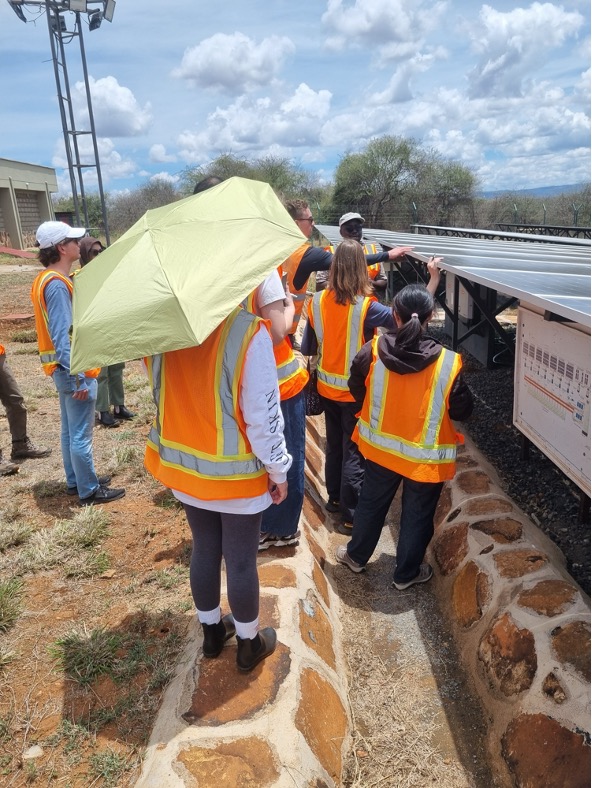
From Mpala’s solar plant to community water systems in Lekiji and Ilmotiok, Laikipia offered visiting Princeton University students a chance to explore energy choices in action. Their October field visit brought them together with Mpala staff and neighbouring communities to examine how different technologies serve research, households and the wider landscape.
The Master in Public Affairs students, from Princeton’s School of Public and International Affairs, were taking part in Clean Energy Transition in Africa, taught by Professor Denise Mauzerall. At Mpala, the course’s policy questions became conversations about the systems people operate, the choices they make and the experience they bring to managing energy.
Mpala’s John Onyango and Piyiet Leshan hosted the students and led the local programme. Drawing on their knowledge of the centre and surrounding communities, they connected visits to energy infrastructure with discussions about its design, use and maintenance.
The programme took in Mpala’s solar plant, Nanja dams and Turbine, and water infrastructure. These systems support the people, facilities and daily activities behind research at the centre. They also provided examples that students could use to examine what makes an energy system dependable over time, from its initial design through routine maintenance and repairs.
Visits to Lekiji and Ilmotiok broadened the discussion. Solar water pumping, household solar systems, biogas and traditional fuels showed the range of energy sources used across the landscape. Community experience brought practical insight into how these options fit different purposes, including supplying water, lighting homes and preparing food.
Operating infrastructure in a wildlife landscape added another dimension. Damage to solar panels at a community borehole prompted discussion about how installations can account for animal movements and behaviour. The example connected engineering with the ecological setting in which a system must function.
Cooking fuels opened conversations about health, convenience and everyday routines. Students considered how cleaner cooking technologies might fit household preferences, alongside questions of cost, access and continued use. These exchanges placed people’s knowledge and priorities at the centre of discussions about energy transitions.
Across the visit, the students followed connections between energy, water, research and community life. Each stop offered a different perspective on sustainability and an opportunity to consider how policy can respond to the conditions in which technologies are used.
John and Piyiet’s guidance helped bring those perspectives together. For the visiting students, Mpala became a place to learn from working systems and the people who know them best, grounding their study of Africa’s clean energy transition in the experience of a shared Laikipia landscape.