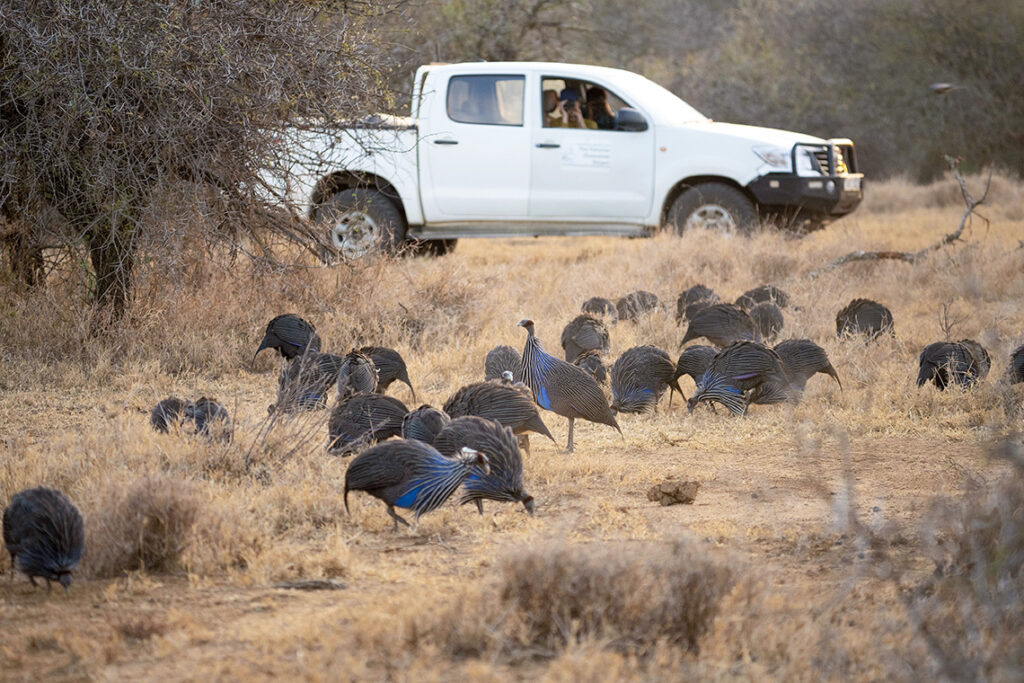
Vulturine guineafowl (Acryllium vulturinum) are the largest and most arid-adapted species of guineafowl. They travel in cohesive groups, spending much of the day foraging on grasses and insects. As environmental conditions oscillate from wet to dry seasons, these birds exhibit remarkable behavioural strategies. As conditions dry up, guineafowl ramp up foraging effort despite the heat, display nomadic movements in search of resources and form ‘super’ groups, which can be over 200 birds strong. This project seeks to understand how these behavioural adaptations help vulturine guineafowl survive in harsh conditions — but how does one begin to answer these questions? By incorporating state-of-the-art technology with lifetime monitoring of individuals!
In 2016, the social lives of these brilliantly blue birds became the focus of the Vulturine Guineafowl Project. In the first three years, the project team trapped and marked a whopping 900 individual birds, and fit solar-powered GPS tags to individuals in every social group in the study area. Ten years on, the project has marked over 2500 birds and tagged nearly 500. The detailed information about the movements and activity budgets of each group using tag-data, combined with daily censuses of group membership, provides the basis for the many findings this project has made. From shedding light on the energetics of movement to the consequences of harsh droughts, and how these processes are altered by living socially.
The team hopes that these unique long-term, large-scale, and high-resolution data will provide the critical pieces for answering key questions about the evolution of animal societies and how species will adapt to novel environmental conditions.