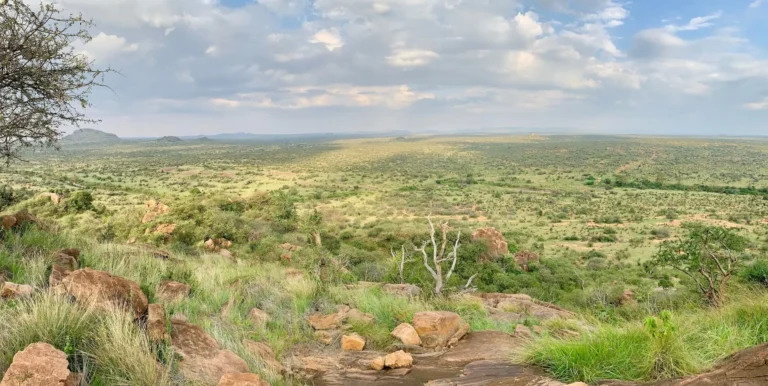

Most of Africa’s wildlife occurs on land shared with livestock, yet most biodiversity research has traditionally focused on protected areas. The Kenya Long-term Exclosure Experiment (KLEE) seek to redress this shortfall through of a series of plots that selectively exclude three groups of large mammalian herbivores: cattle (C), meso-herbivore wildlife weighing 25-900kg (W), and mega-herbivores (M: elephants and giraffes).
Using different semi-permeable barriers, six herbivore treatment combinations are created: O (no large herbivores allowed), C (only cattle allowed), W (meso-herbivore wildlife only), WC (cattle and meso-herbivore wildlife), MW (all wildlife groups without cattle), MWC (all wildlife groups and cattle). Each plot is 4 hectares (200m x 200m), arranged into three blocks, each containing six the six herbivore treatments adjacent to each other. Further details of the experimental design are provided in Young et al. (1997).
Since its establishment in 1995, KLEE has incorporated multiple nested experiments to test additional ecological stressors. These include rodent exclosures (initiated in 1995), over-grazing treatments (2008), controlled burning regimes conducted annually and triennially (2013), NutNet and DRAGNet plots (2024), and recently, experimental reversals (2026). Complementary off-plot experiments include tree clearing and livestock corral (“boma”) placements. Termite mounds and multiple droughts over the past thirty years provide additional layers of stressor/disturbance. One of the themes of current research at KLEE is how these different stressors, singly and in combination, influence stability/resilience of savanna rangeland ecosystems.
Click here to read more about the research.
Publications:
KLEE is the most productive field experiment ever conducted in Africa. As of 2025, it has generated 175 peer-reviewed publications and 35 outreach articles. The project has hosted (and funded) 20 Kenyan graduate dissertations and 18 dissertations from United States and other countries. The results of all these are too many to adequately summarize here, but KLEE has greatly expanded our understanding of savanna rangeland ecology, management and conservation.