Field Guide
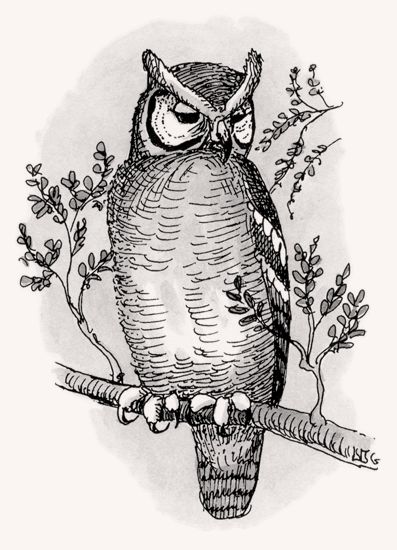
Bubo lacteus
Verreaux’s Eagle-Owl
Swahili: Bundi, Kokoko


- Type
- Bird
- Daily Rhythm
- Nocturnal
- Diet
- Carnivorous
- Life Span
- In captivity: 30 years
- Weight
- Up to 3.5 lb (1,600 g)
- Size
- 23.5 to 25.5 in (60 to 65 cm) long

The largest owl in Africa, Verreaux’s eagle-owl lives up to its dual name, gliding down on silent wings to snatch unwary prey by night and looking fierce and stern as an eagle as it roosts by day.
Verreaux’s eagle-owls are monogamous and territorial, with females being substantially larger than males. Several owls will often roost together during the day, then scatter for solo hunts at night.
Pairs mark and aggressively declare their territory with calls and song that can be heard as far as three miles (5 km) away.
This owl spends most of the day roosting on a familiar shaded branch, waiting for night. Hunting usually begins soon after twilight.
The population of Verreaux’s eagle-owls is considered stable, so these birds are listed as lower risk by the International Union for Conservation of Nature (IUCN).
The principal prey of the Verreaux’s eagle-owl are small mammals, including monkeys and hedgehogs. They also eat reptiles, fish, and frogs, turning to carrion when live prey is scarce.
Verreaux’s eagle-owls usually breed from March to September. During courtship, a monogamous pair slightly flaps their wings and bobs up and down, producing fast stuttering hoots. These birds usually breed every year, but a shortage of prey can delay breeding for two or three years. Usually, two eggs are laid and incubated for 32 to 39 days by the female, while her mate hunts and brings back food. Usually only one chick survives. It stays in the nest for about two months and within its parents’ territory for as long as two years.
This raptor is often spotted in the riverine and acacia woodlands of Kenya.
This huge owl is found in sub-Saharan Africa, except for the Namibian desert and tropical rain forests. It is found in a variety of habitats—from woodland and dense forests to savannas and semi-deserts—at elevations from sea level to 9,800 feet ( 3,000 m).