Field Guide
Papio anubis
Olive Baboon
Swahili: Nyani


- Type
- Mammal
- Daily Rhythm
- Diurnal
- Diet
- Omnivorous
- Life Span
- In the wild: 25 to 30 years
- Conservation Status
- Lower risk
- Weight
- Male: 53 lb (24 kg) Female: 28 lb (12.7 kg)
- Size
- Male: 28 in (70 cm) high at shoulder Female: 24 in (60 cm) high at shoulder

The olive baboon’s ability to adapt allows it to live in all kinds of geographic areas and eat a variety of foods. However, this adaptability can also cause a problem for these primates. Baboons often help themselves to crops and other food in populated areas, making them a nuisance to residents.
Olive baboons are very social creatures and live in groups called troops, ranging in size from 12 to 130 individuals. Females stay in their mother’s group, while males join other groups when they are six to nine years old. Within each group, males and females have social hierarchies. Female dominance is inherited. The youngest daughter assumes the rank below her mother and above her older sisters. Males, however, must use aggressive behavior to gain dominance within the group.
Olive baboons communicate within their group using barks, growls, grunts, screams, and coughs. Adult males make a loud wahoo call, either spontaneously or during aggressive encounters. Their call can be heard as far as 1.9 miles (3 km) away!
At the beginning of the day, olive baboons sunbathe in their sleeping spots, which can be either in trees, on rocky outcrops, or on cliffsides. Then they spend 20 to 50 percent of the daylight hours eating before returning to a safe sleeping spot at dusk.
Humans are the main threat. Olive baboons destroy crops, so farmers consider them vermin and trap, poison, and hunt them.
Since olive baboons eat almost everything, it is easier to list foods they don’t eat than ones they do. Their diet depends on where they live, the season, and the time of day. Although plants account for the majority of their food choices, they get their protein from eating small prey, including hares, mice, and small antelopes such as Thomson’s gazelles.
Olive baboons mate throughout the year. Males compete to mate with a female, sometimes teaming up to challenge a more dominant male. Gestation lasts for 180 to 185 days, and the young are not weaned until 300 to 480 days after birth.
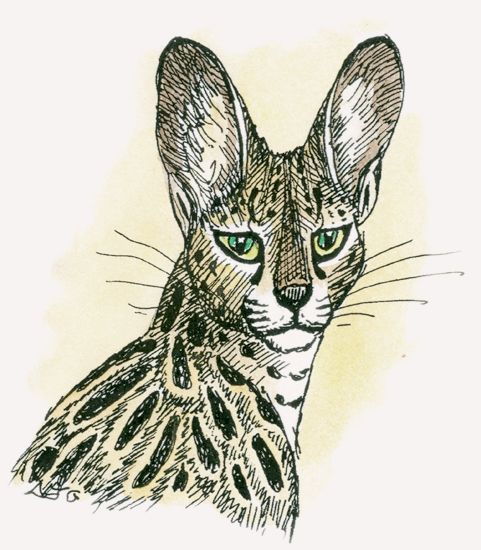
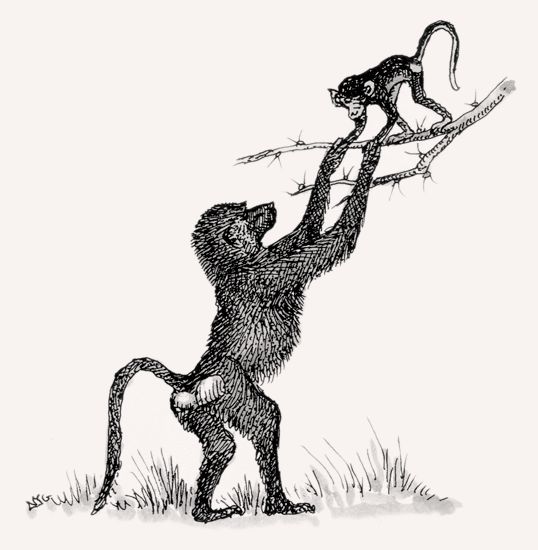
Olive baboons sometimes hunt Thomson’s gazelles and vervet monkeys for food, but these primates also hang around these animals because they serve as lookouts for mutual predators such as lions, leopards, servals, wild dogs, hyenas, chimpanzees, and crocodiles.
Previous Next
Widespread across tropical Africa, olive baboons are found mostly north of the Equator and south of the Sahara in a variety of vegetation and climate conditions. They’re especially plentiful in forested areas.
Olive baboons choose habitats with easy access to water and to secure sleeping sites in large trees, on steep cliff faces, or in rocky outcroppings. Groups change their sleeping sites every few days.
Olive baboon populations seem to be increasing.The International Union for the Conservation of Nature (IUCN) says their population is a “species of least concern,” despite “vigorous” hunting, trapping, and poisoning by humans.