Field Guide
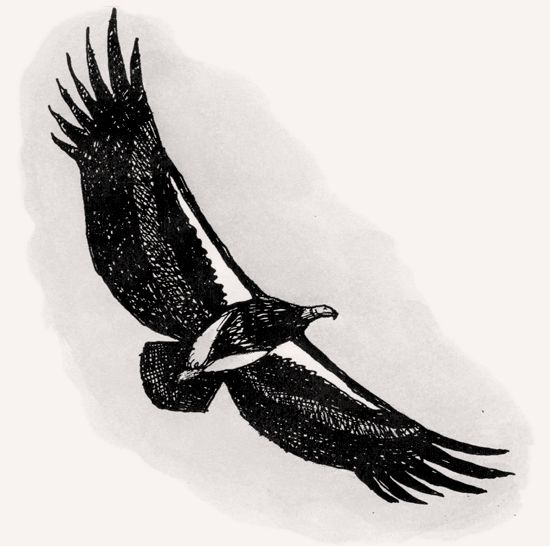
Torgos tracheliotus
Lappet-faced Vulture
Swahili: Tumbusi


- Type
- Bird
- Daily Rhythm
- Diurnal
- Diet
- Carnivorous
- Life Span
- 50 years, maximum
- Conservation Status
- Vulnerable
- Weight
- Male: 14.3 to 20.2 lb (6.5 to 9.2 kg); Female: 23.1 to 30.6 lb (10.5 to 13.9 kg)
- Size
- 39 to 45 in (100 to 115 cm) long; 10 ft (3 m), wingspan

Strong, big, and bold, a lappet-faced vulture drives away smaller carrion-eaters, including jackals. Feasting on a big mammal’s body, this vulture tears through the thick hide, providing entrances for smaller, weaker competitors to feed.
Although normally found alone or in pairs, lappet-faced vultures will sometimes congregate in small numbers, usually near water holes.
Lappet-faced vultures are well equipped for getting their food, which is mainly carrion. Searching for dead animals, they soar and glide on broad wings and look down with sharp eyes. A powerful hooked bill can tear into hide and sever tendons. Considering where its head must go, this vulture must appreciate having a featherless head and neck.
The lappet-faced vulture has gone extinct in Israel, Jordan, and the western Sahara. It is listed as vulnerable by the International Union for Conservation of Nature (IUCN).
Lappet-faced vultures feed mostly on carcasses, but they also attack young and weak living animals, raid the nests of other birds, and steal from smaller vultures.
Lappet-faced vultures usually breed throughout the year. One egg per clutch is typical. The egg is incubated by both parents for 54 to 56 days. The chick will fledge in 125 to 135 days, remain dependent upon its parents for some time. It will not be ready to breed until it is about six years old.
Lappet-faced vultures die when they eat carcasses that farmers have laced with poison to kill marauding lions. This has become enough of a problem to reduce vulture populations in many parts of Africa, including Laikipia.
The lappet-faced vulture’s population in Kenya is declining and is mostly found in protected areas.
Lappet-faced vultures live in parts of northern, eastern, and southern Africa. They are also found in several countries in the Middle East.