Field Guide
Hybrid of Alcelaphus buselaphus cokei and Alcelaphus buselaphus lelwel
Laikipia Hartebeest
Swahili: Kongoni


- Type
- Mammal
- Daily Rhythm
- Diurnal
- Diet
- Herbivorous
- Life Span
- In the wild: 12 years (males); 15 years (females) In captivity: 22 to 23 years
- Conservation Status
- Lower risk overall; Endangered locally, including at Laikipia
- Weight
- Male: 284 to 352 lb (129.0 to 159.8 kg) Female: 256 to 298 lb (116 to 135 kg)
- Size
- Male: 3.7 to 3.9 ft (1.1 to 1.2 m) high at shoulder Female: 3.6 to 3.8 ft (1.1 to 1.2 m) high at shoulder
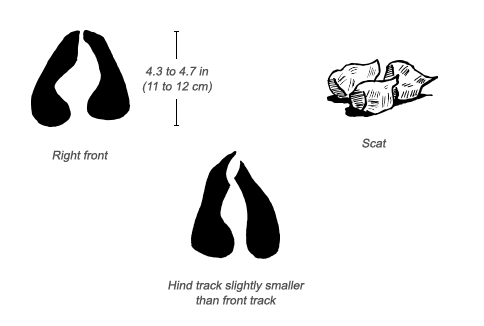

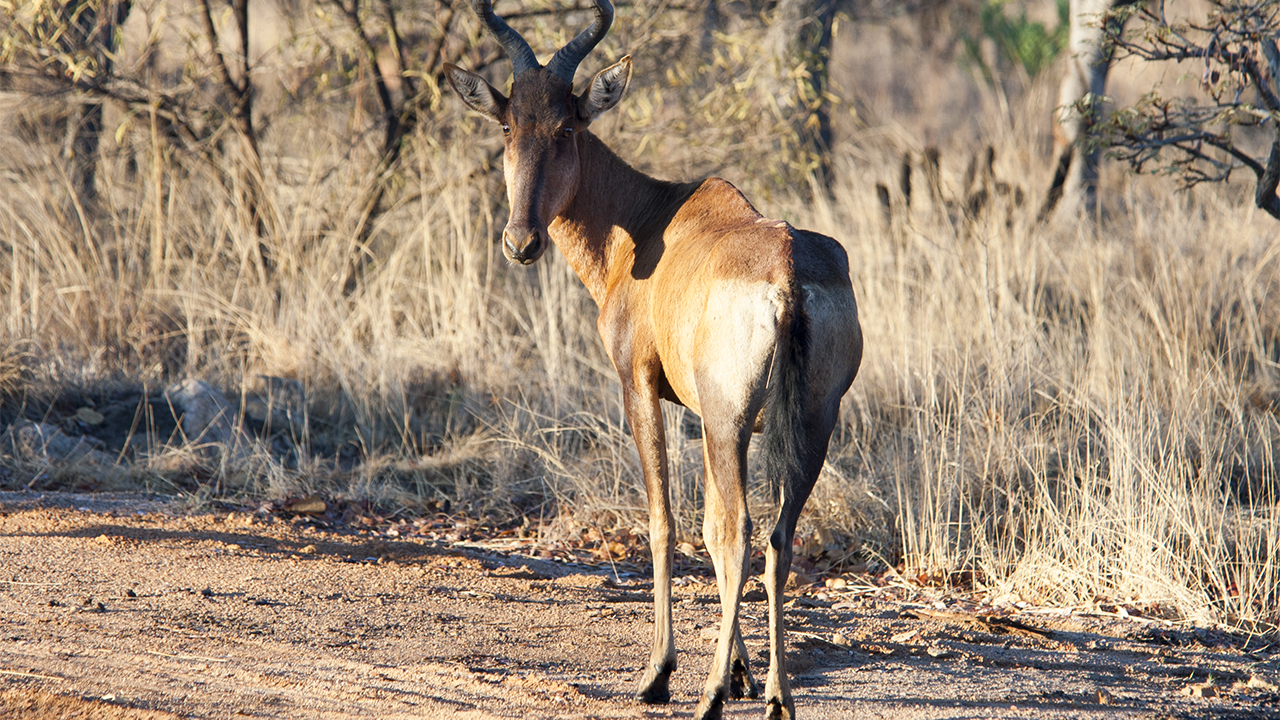
With its long, narrow face, sloping back, and slightly humped shoulders, the hartebeest isn’t as graceful looking as some of its relatives, yet this antelope is well adapted for surviving on the savanna. Eyes high on its head allow it to spot predators even while grazing; long, thin legs help it maintain high speeds for great distances; and its complex and varied horn structure is designed to protect the head during violent clashes. The Laikipia hartebeest, a hybrid of two subspecies, lives at Mpala.
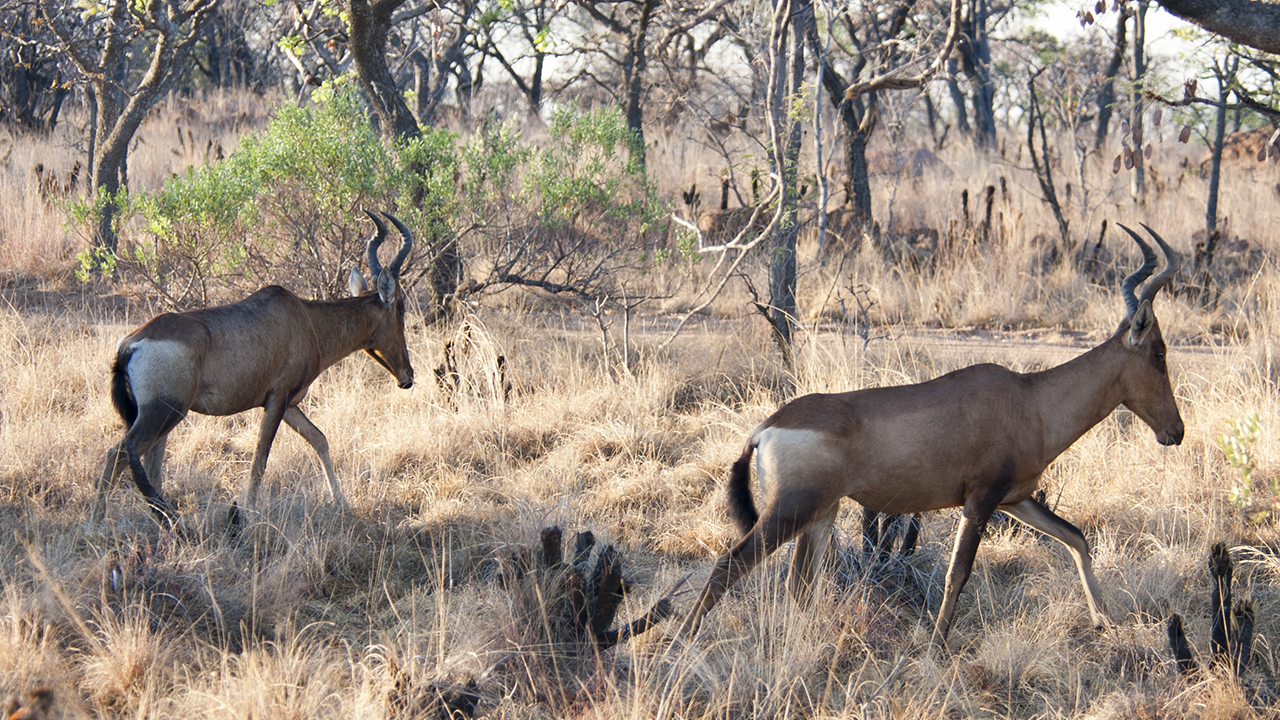
The only consistent bond among hartebeests is between mothers and their young, though this association weakens as more offspring are born. Female hartebeests assemble themselves into defined groups, though these units break apart and reform as females move about to find areas with the best grass and water sources, especially during the dry season. Males are territorial and compete fiercely to gain and defend areas they know females are most likely to visit. When a male holds a region, he becomes dominant over all other males that enter it. Only male hartebeests with a territory mate. Non-territorial males form bachelor herds of as many as 100 individuals.
Hartebeests communicate using a small number of vocalizations. Both calves and young adult males trying to show subordination to a dominant male emit a quack -like call. Hartebeests warn of predators using an alarm snort, varying the volume according to the level of danger. When a predator approaches, the hartebeest faces it directly, holding its head as high as possible, with its nose down and its ears pointed forward. Sometimes a hartebeest will follow the predator to keep it in sight. Even if a hartebeest doesn’t see the predator, it will spread the message that an enemy is near by picking up its neighbors’ alarm stance and snort.
Like other ungulates, hartebeests alternate between resting, grazing, and ruminating from dawn until dusk. The actual pattern of activity for each of these behaviors varies slightly according to the subspecies as well as the season. (Scientists aren’t sure what hartebeests do at night.) Males are territorial and often fight to establish dominance and defend territories. Once a male successfully attains a territory, he scent-marks its boundaries by leaving piles of dung. Female hartebeests occasionally fight each other by clashing horns, mainly when they are competing for food or water.
Because there has been little recognition of population distinctions among hartebeest subspecies, they are listed as being of lower risk by the International Union for Conservation of Nature (IUCN) even though one species has gone extinct and three others are listed as endangered or critically endangered. The Laikipia hybrid is also endangered. Although there is no agreement on the reasons for its declining numbers, lion predation and changing habitat are suspected. The one notable exception to this declining trend is the red hartebeest in southern Africa. Its populations are actually increasing as a result of demand from the trophy-hunting industry.
Hartebeests are specially adapted for their diets and for surviving drought. Their long, slender nose allows them to select particularly high quality parts of older medium or tall grass. This enables them to continue grazing long after other ungulates have been forced to switch to browsing in order to find nutrients during the dry season. Their small appetites, low metabolic rates, and highly efficient digestive system allow hartebeests to out-compete, and often take the place of, other species. These features are likely what allowed them to establish such a broad range across Africa.
Previous Next
Hartebeests range south of the Sahara from western to eastern Africa, then down into the southeastern and southern parts of the continent.
Although generally associated with grasslands, hartebeests tend to avoid large plains. In densely wooded areas, these antelopes remain on the edges of forests or in clearings. Hartebeests occupy an array of savanna habitats that vary in climate, structure, and openness. They have even been known to live as high as 13,000 feet (4,000 m) on Mount Kenya! Any habitat must have a source of drinking water.
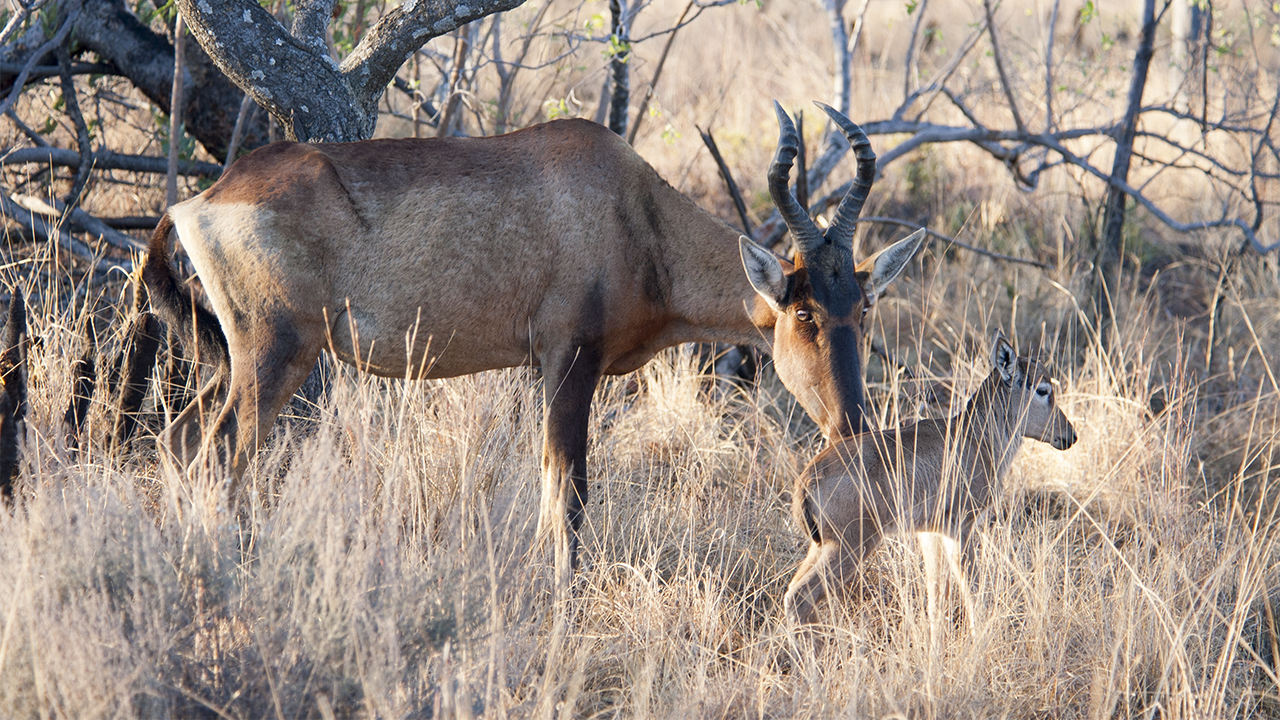
The movement of female hartebeest herds determines the mating structure of the population. When there is a low density of male contenders or when resources are unstable, males use either a “sit and wait” strategy (staying in one place until the female herd comes by) or they follow the female herds as they move through their home range. Otherwise, a male will court females when they enter his territory. The male stands in front of or walks away from a particular female, then stares at a spot in the distance, a tactic intended to frighten the female into stillness but not scare her away. Occasionally, neighboring males will dart into the mating male’s territory in an attempt to disperse the female herd into their own territories. Females have their first calf when they are between the ages of 15 and 24 months. Males, on the other hand, do not mate until they obtain a territory, usually after three years of age. After a gestation period of eight months, a female separates herself from the group and gives birth to a single calf. The calf enters a “lying out” period for about two weeks, and only comes out of hiding to feed. Calves are weaned when they are about seven to eight months old.
Although wildebeests prefer short grasses and hartebeests graze on tall grasses, there is evidence that wildebeests like the company of hartebeets because of this antelope’s extreme vigilance in watching for predators, especially lions, spotted hyenas, and African wild dogs. Hartebeests have fewer ticks than other ungulates, so they don’t need the services of oxpeckers and will even chase them away.Their biggest threat comes from domestic livestock. As the population of cattle grows, the grazing land for hartebeests shrinks, threatening them with starvation.
Hartebeest populations are decreasing drastically throughout their range, with the exception of some parts of southern Africa. Most of this decline is due to an increase in livestock and agricultural farming as well as in hunting for bush meat. Currently, the entire hartebeest population is about 360,000 individuals. The population of the Laikipia hartebeest is less than 1,000.