Field Guide
Tockus deckeni
Von der Decken’s Hornbill
Swahili: Fimbi kahawia, Hondo hondo


- Type
- Bird
- Daily Rhythm
- Diurnal
- Diet
- Carnivorous
- Life Span
- In the wild: 10 to 15 years
- Conservation Status
- Lower risk
- Weight
- 5.1 to 6.9 oz (145 to 195 g)
- Size
- 19 inches (48 cm) long

Hornbills are noisy, conspicuous birds easily distinguished by their bold black and white feather patterns, accented by long, colorful bills and patches of bare skin around the eyes or throat. Of the world’s 56 species of hornbills, 23 live in sub-Saharan Africa. Von der Decken’s hornbills are common to East Africa, from central Ethiopia to central Tanzania.
Von der Decken’s hornbills maintain year-round pair bonds that can last for a decade or more. A new partner is chosen only when one of the birds dies.
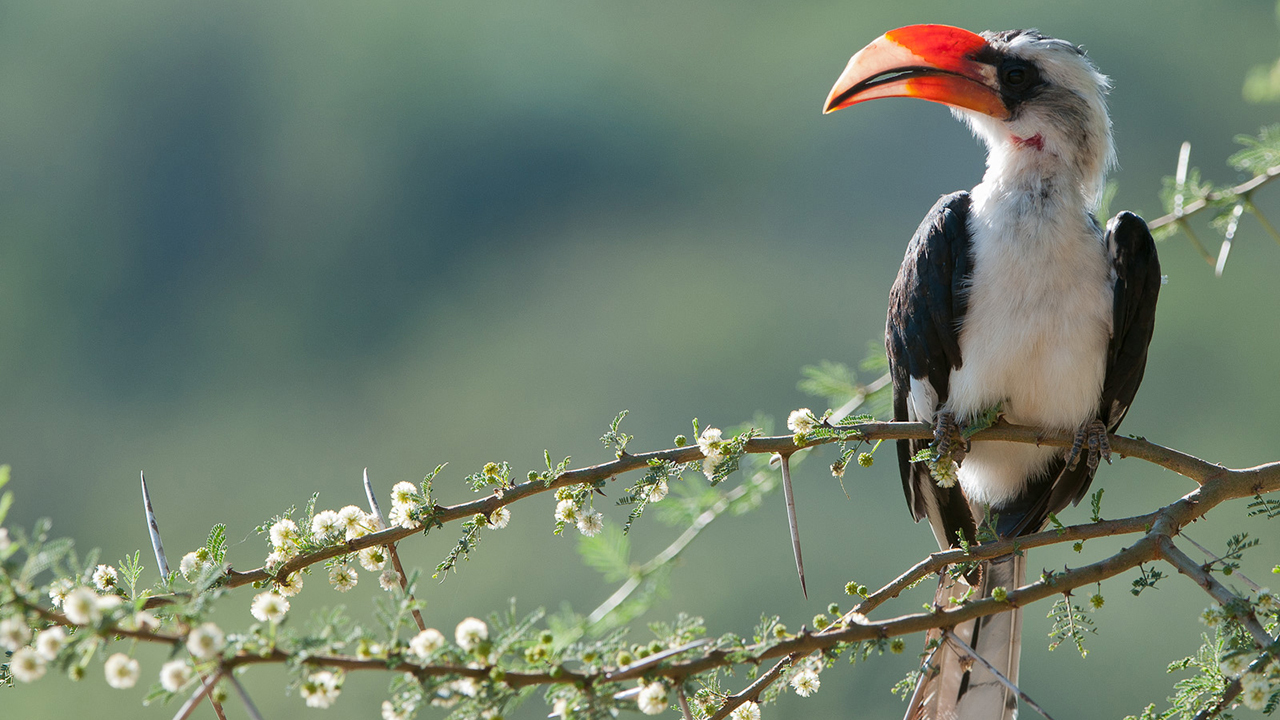
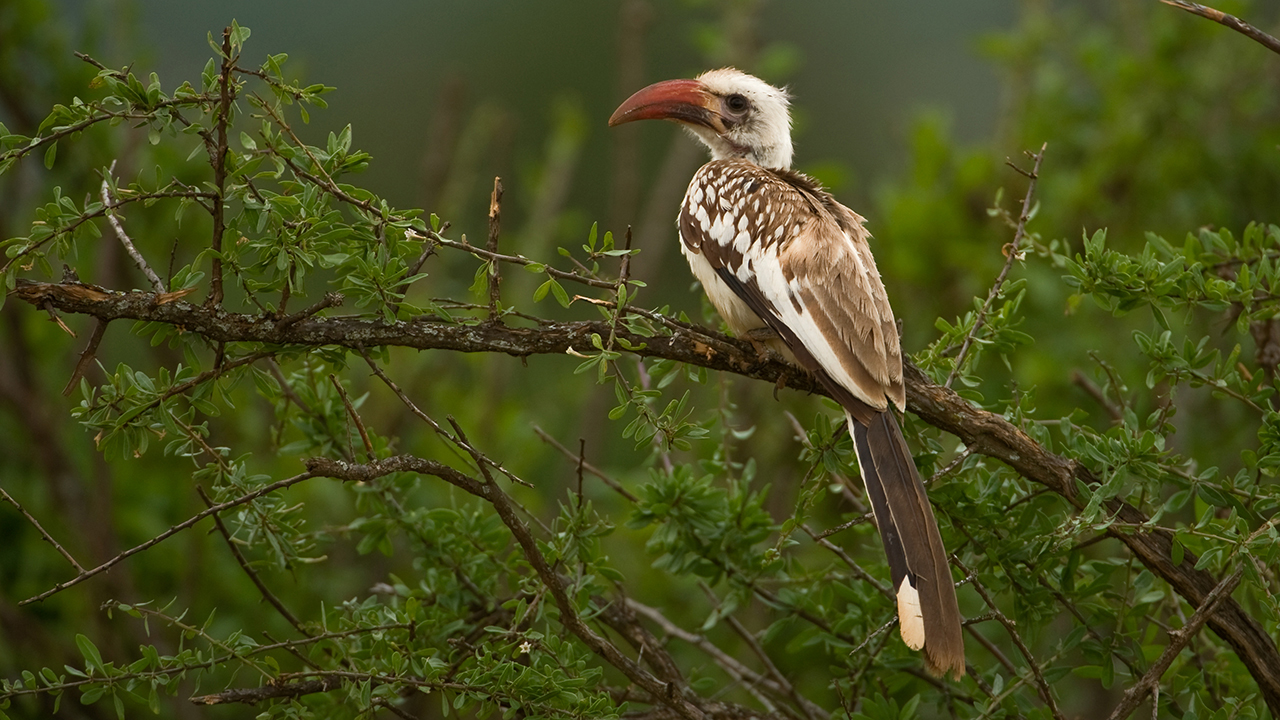
Like all hornbills, von der Decken’s tend to be talkative and noisy. Their characteristic vocalization consists of a long, low-pitched series of tok, tok, tok, tok, tok, tok, tok. These hornbills communicate their sex and age through differences in bill color. Juveniles and adult females sport shorter, solid black bills, while adult males have longer, yellow bills with bright orange bases.
Von der Decken’s hornbills are highly curious, pugnacious birds that can become quite comfortable around human settlements. They are commonly seen tapping furiously on house windows—possibly communicating to other hornbills nearby, or simply worried that their reflection is a rival.
Although von der Decken’s hornbills are plentiful, the cutting of trees for charcoal production poses an increasing threat because people tend to remove the large trees that hornbills require for nesting.
Von der Decken’s hornbills eat insects, scorpions, lizards, small snakes, mammals, and—occasionally—fruit.
Like all hornbills, von der Decken’s are hole-nesters, using natural cavities in trees or rock crevices. But unlike other hole-nesters, female hornbills use mud and feces to make a brick-hard seal over the cavity opening, leaving only a narrow slit through which she and her chicks receive food from her mate. In northern Kenya, a female von der Decken’s enters the nest hole in April or May and seals herself in. She lays as many as four white eggs, all of which hatch at different times. The female remains sealed in for approximately three months. When the nest hole gets too cramped with her growing chicks, she chisels her way out, leaving the chicks to reseal the hole. Early hatchers tend to outcompete their younger siblings for food. As a result, It is rare that there are more than two fledglings.
Hornbills cannot excavate their own nest holes, so they rely on others that can, especially woodpeckers and barbets. Von der Decken’s hornbills are targeted by large birds of prey, and are occasionally eaten by snakes, genets, and mongooses.
Von der Decken’s hornbills live throughout the dry, acacia woodlands of East Africa. In Kenya, they can be found from the low-lying coast to the high up-country plateaus and the flanks of Mount Kenya.