Field Guide
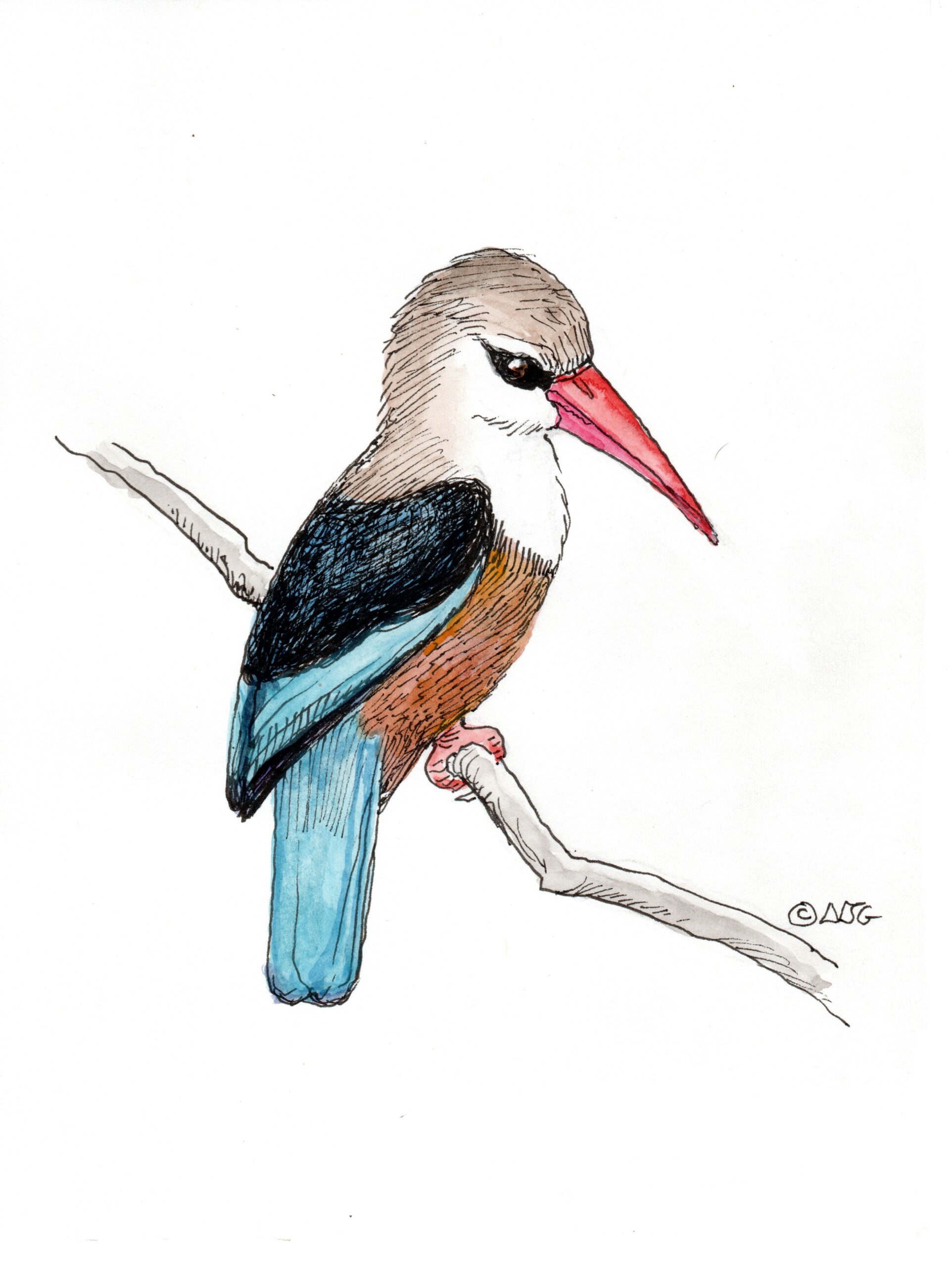
Halcyon leucocephala
Grey headed kingfisher
Swahili: Kurea tumbo jekundu


- Type
- Bird
- Daily Rhythm
- Diurnal
- Diet
- Carnivorous
- Size
- Length: 21 cm (8.3 inches)
The grey-headed kingfisher are known for their dramatic dive-bombing tactics to protect their nests from predators like monitor lizards. Imagine an eight-inch bird fearlessly swooping down on a six-foot lizard – it’s like a real-life action movie in the bird world!
Overall, their social interactions are minimal, focusing primarily on mating pairs and territorial defense. Their nests are usually built in tree cavities or termite mounds, where they lay 2-4 eggs. Both parents take part in incubating the eggs and feeding the chicks once they hatch. Despite their preference for dry habitats, they are often found near water sources, which provide ample hunting opportunities.
Their warning calls are a series of identical sharp notes. The song is repeated in rising and falling waves of notes which are loud and harsh.
The grey-headed kingfisher is known for its solitary and territorial nature, often perching quietly on branches, scanning the ground for prey such as insects, small reptiles, and occasionally small fish. When they spot something, they swoop down swiftly to catch it with their sharp beak. During the breeding season, which typically coincides with the rainy season, they become more vocal and can be heard making loud, repetitive calls to attract mates and defend their territory.
The species has an extremely large range and the population is stable.
The grey-headed kingfisher’s diet primarily consists of insects, such as grasshoppers, beetles, and caterpillars, as well as small reptiles like lizards. Occasionally, they may also catch small fish and amphibians. Their hunting technique involves perching quietly and watching for movement before swooping down to capture their prey with precision.
When it comes to nesting, grey-headed kingfishers prefer tree cavities or abandoned termite mounds. They typically lay 2-4 eggs, which are incubated by both parents. The chicks are fed a diet of regurgitated insects and small animals, and they fledge after about three weeks. The parents continue to care for the young birds for a short period after they leave the nest, ensuring they are well-prepared for independent life.
The grey-headed kingfisher has a few notable interactions with other species in its environment. Among its friends, or rather beneficial relationships, are other bird species that share its habitat. However, it also faces threats from various predators and competitors.
The species has an extremely large range and the population is stable.
The grey-headed kingfisher has a wide distribution across tropical and semi-tropical regions of Africa and the Arabian Peninsula. Its range extends from the Cape Verde Islands off the northwest coast of Africa, through Mauritania, Senegal, and Gambia, eastward to Ethiopia, Somalia, and southern Arabia, and southward to South Africa.