Field Guide
Plegadis falcinellus
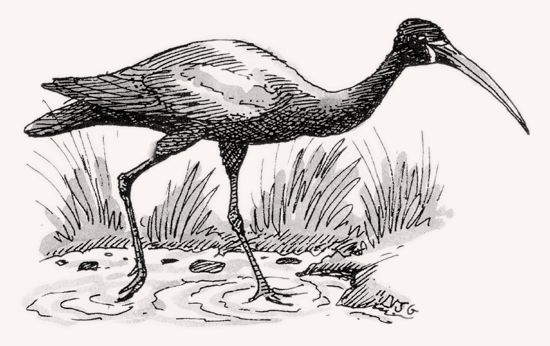
Glossy Ibis
Swahili: Kwarara mwekundu


- Type
- Bird
- Daily Rhythm
- Diurnal
- Diet
- Carnivorous
- Conservation Status
- Lower risk
- Weight
- 17.1 and 20.5 oz (485 to 580 g)
- Size
- 19 to 26 in (48 to 66 cm) long; 31.5 to 37.4 in (80 to 95 cm) wingspan

In ancient Egypt, the sacred ibis symbolized Thoth, the god of wisdom and learning. Images of the graceful bird appeared in hieroglyphics and carvings. Today the glossy ibis has no heavenly status, but its earthly range extends to every continent but Antarctica.
Glossy ibises typically feed in small flocks and nest in communal groups. In southern Africa, the glossy ibis often flies behind weather fronts that transform arid lands into temporary oases.
The global population of the glossy ibis is not known, but some areas have experienced a loss in numbers, while other have observed increases. In addition to human-induced causes, these birds have also suffered losses due to avian flu. Overall, the glossy ibis is listed as lower risk by the International Union for Conservation of Nature (IUCN).
Striding along in shallow water or on soft ground, small flocks of ibises snatch up insects. They also follow crocodiles and hippopotamuses, feeding on crustaceans, frogs, lizards, and even small mammals that these large animals stir up as they move through the water. These birds will also eat rice and other grain from cultivated fields. They have sensors on their bills that alert them to the presence of prey.
Monogamous pairs breed in colonies made up of a variety of species of ibises that may number in the thousands. Both adults help build their nest, which is made out of reeds, sticks, and branches and lined with grass or leaves. Between September and February in South Africa (and November to April farther north), females lay two to four eggs, which are incubated by both parents for about 20 to 23 days. About two weeks after hatching, the chicks begin to fledge. They can usually fly and feed themselves about 40 days after hatching. After the breeding season, the large colonies break up, with ibises migrating to other areas.
Predators of the glossy ibis include birds of prey and the Nile crocodile.
Outside of southern Africa, the glossy ibis lives in southwestern Kenya and along Lake Turkana and can be seen at Mpala’s hippo pool.
Glossy ibises gather in pairs or small groups around wetlands, along shores of shallow lakes and rivers, as well as on floodplains, marshes, and irrigated fields. The birds are locally common in central and southern Mozambique, Zimbabwe, northern and southern Botswana, northern Namibia, and central and southwestern South Africa.