Field Guide
Pycnonotus barbatus
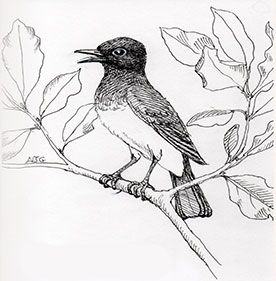
Common Bulbul
Swahili: Shore


- Type
- Bird
- Daily Rhythm
- Diurnal
- Diet
- Omnivorous
- Conservation Status
- least concern
- Weight
- 30-50 g
- Size
- Length: 15-20 cm

The common bulbul lives up to its name, as it is one of the most common birds in Africa and is at home in a range of environments.
Although they are monogamous during breeding, sometimes as many as a hundred common bulbuls will flock together. When foraging they might set out in pairs or as a small family, but also join forces with larger groups.
Common bulbuls have a wide repertoire of calls, from shrill alarms to staccato warnings to soft welcome chattering. Individual males can have several distinctive “phrases” that are shared by as many as two dozen males nearby.
Bold, active, and gregarious, common bulbuls have adapted to sharing their habitats with humans and like to sit atop a bush or other perch, calling away.
Least concern
Common bulbuls consume a wide range of fruits and berries, and also eat flowers, nectar, seeds, and insects; sometimes they break into termite mounds.
During breeding season, males begin singing continuously at dawn for at least half an hour. Females will take more than a week to build a nest, sometimes fastening it to a branch with spider webs, and incubate the eggs until they hatch. When chicks first leave the nest they can barely fly and stay together on nearby branches.
Jacobin cuckoos and other cuckoo species will lay their eggs in common bulbul nests, and shrikes and mongooses will prey on chicks.
Common bulbuls are very common and widespread in Kenya.
Common bulbuls are found throughout much of sub-Saharan Africa, as well as along the Nile Valley and the Mediterranean coast in Morocco, Algeria, and Tunisia.