Field Guide
Tragelaphus scriptus
Bushbuck
Swahili: Mbawala, Kulungu, Pongo


- Type
- Mammal
- Daily Rhythm
- Diurnal & Nocturnal
- Diet
- Herbivorous
- Life Span
- In the wild: 12 to13 years
- Conservation Status
- Lower risk
- Weight
- Male: 64 to 119 lb (29 to 54 kg) Female: 53 to 75 lb (24 to 34 kg)
- Size
- Male: 25 to 30 in (63.5 to 76.2 cm) high at shoulder Female: 24 to 26 in (61 to 66 cm) high at shoulder

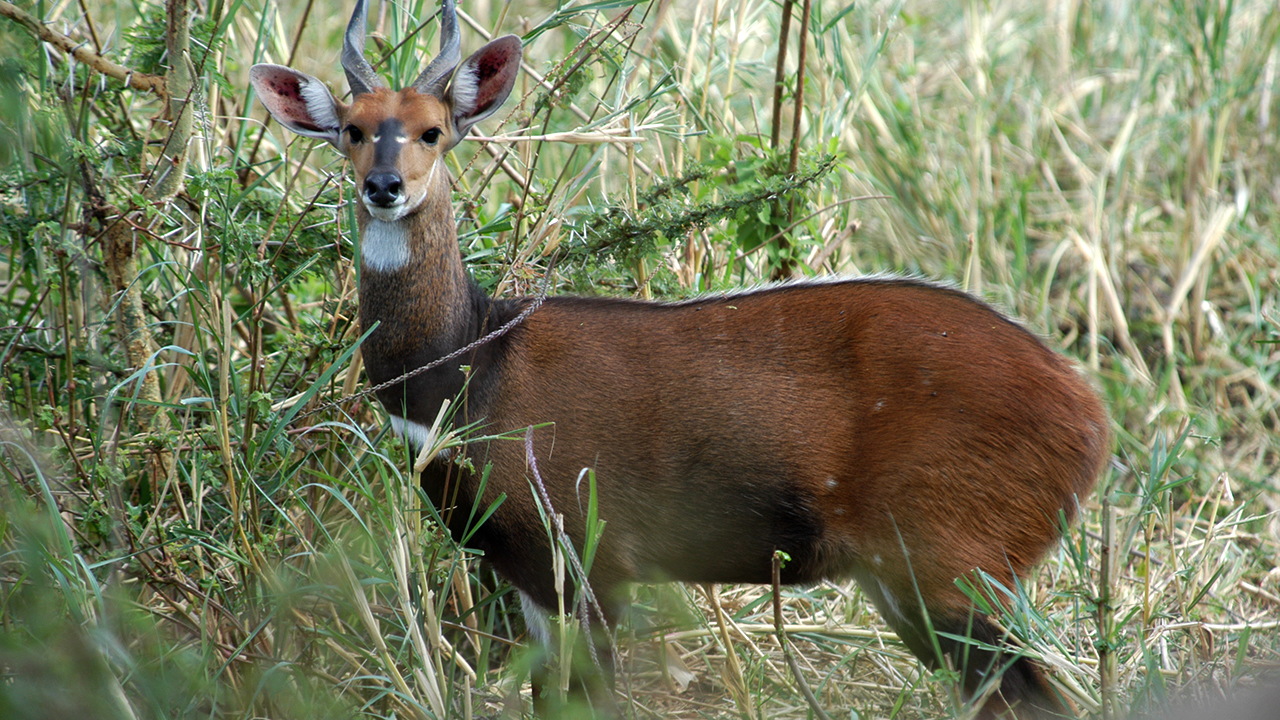
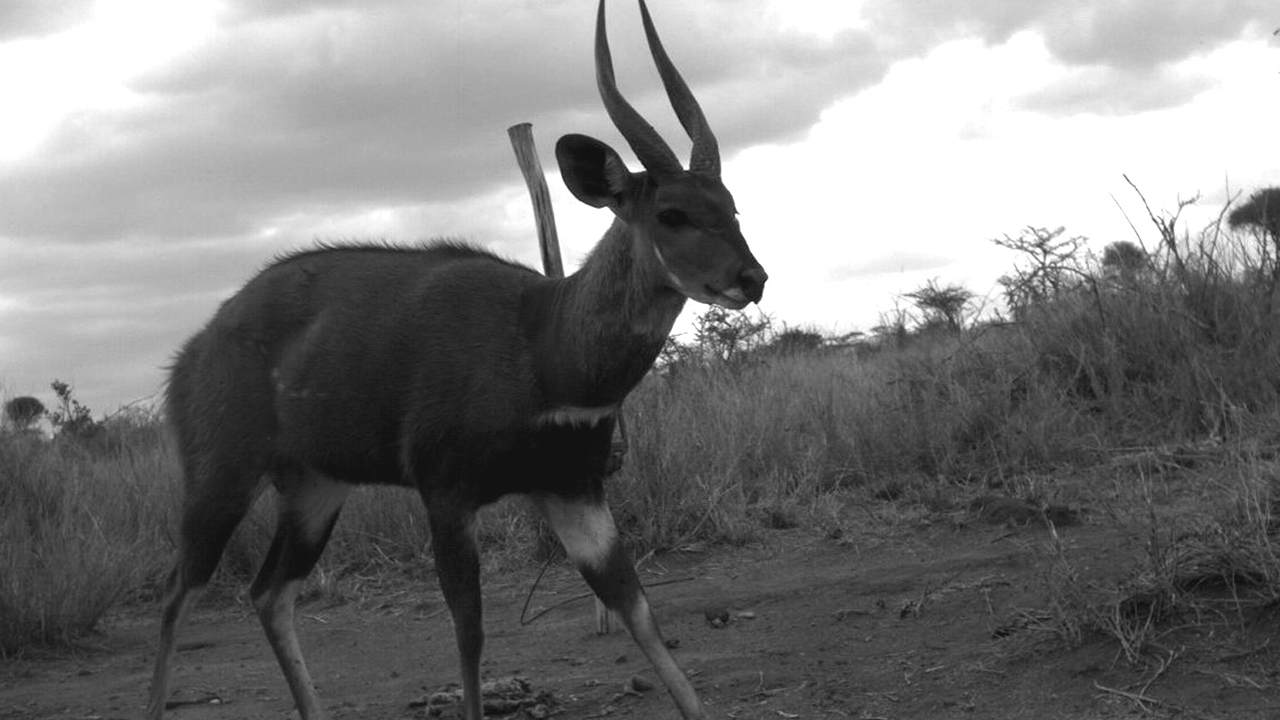
Bushbucks are one of the most widespread kinds of African antelopes. Their small size, coloring, and reclusive behavior help them survive close to human settlements and in very small habitats. Bushbuck horns have a single twist and smooth edges. This design is well-suited to their preference for dense habitat, as the horns do not hinder their escape from predators.
Although bushbucks usually live alone, they occasionally spend time in pairs or even in small groups of adult females, adult females with young, or adult males. A unique social structure is exhibited by bushbucks In Uganda. There, female young remain with their mothers throughout their lives, and adult females organize themselves into matrilineal clans. Each related group maintains and defends a home range against unrelated females. Related females also engage in grooming and other social activities. Males leave their mother’s home range to join a bachelor herd when they are six months old, and fight other male groups to gain territory.
Bushbucks are solitary creatures that communicate mainly through scent-marking rather than vocalization, although they occasionally emit a bark to warn of danger. A male bushbuck signals a challenge to another male by adopting a rigid walk, raising his head, arching his back, and lifting his tail. If the opponent is an equal match, he takes up a similar posture and the two circle one another; if the opponent submits, he keeps his head low and licks the dominant male. Some researchers think males may bark to indicate their status to another bushbuck.
Bushbucks spend most of their time eating, ruminating, resting, and moving. They are most active at dawn and dusk, though this varies based on season, age, and sex. Males are often combative. A male will first feign an attack by lowering his horns to the ground, but if he and his opponent are closely matched, they will lock horns and try to stab each other’s sides. While female bushbucks can be aggressive toward other females, they tend to fight much less than males. Bushbucks have a keen sense of smell. When either a male or a female senses a predator in the distance, they freeze and drop to the ground, keeping their head and neck against the earth until the danger passes. If the predator is close, a bushbuck will emit a bark and flee into the bush with its tail raised.
Although there is no serious threat to bushbuck populations, some are being reduced by habitat destruction due to human activity. In some areas, habitats are being taken over by smaller species, particularly the common duiker, Their hides make bushbucks a target for hunters.
Bushbucks are browsers. They eat a range of herbs and young leaves from both shrubs and trees throughout the day and night. They also raid farms and plantations to eat crops.
During courtship, the male nuzzles and licks the female, strokes her back with his cheeks, and presses his head or neck against her. If the female accepts his advances, the male guards her from any other eager males. Female bushbucks gestate for 24 to 35 weeks and usually bear a single calf, though occasionally they have twins. Females give birth in dense thickets, where the calves remain for up to four months while their mothers leave to graze. A male’s horns begin to emerge at seven months. Males reach sexual maturity at ten months, but most do not breed until they are two years old. Females reach maturity between 14 and 19 months and can give birth every year.
It’s not unusual to find baboons and vervet monkeys hanging around bushbucks. These primates have learned that this antelope’s bark means a predator is near and it’s time to flee. In return, bushbucks benefit from the primates’ ability to detect predators from trees. Leopards are the primary enemy of bushbucks, but lions, hyenas, and crocodiles are among the other animals that prey on them.
From West Africa to Central Africa and from northeastern Africa to southern Africa, bushbucks successfully inhabit 40 African countries. They even live on the small islands off the west coast. The only country south of the Sahara that is not home to the bushbuck is Lesotho.
Bushbucks live in a wide range of habitats, although they prefer forested or wooded regions close to a water source. They can live on mountain slopes as high as 13,120 feet (4,000 m) in East Africa as well as in regions settled by humans.
The total bushbuck population in Africa is estimated at 1.34 million. However, this number may be underestimated, as the animal’s elusive behavior makes it difficult to study and count.