Field Guide
Oryx beisa
Beisa Oryx
Swahili: Choroa


- Type
- Mammal
- Daily Rhythm
- Diurnal
- Diet
- Herbivorous
- Life Span
- In the wild: 20 years
- Conservation Status
- Near threatened
- Weight
- Male: 369.9 to 461.6 lbs (167.8 to 209.4 kg) Female: 255.7 to 415.4 lbs (116.0 to 188.4 kg)
- Size
- Male/female: 41.3 to 45.3 in (105 to 115 cm) high at shoulder

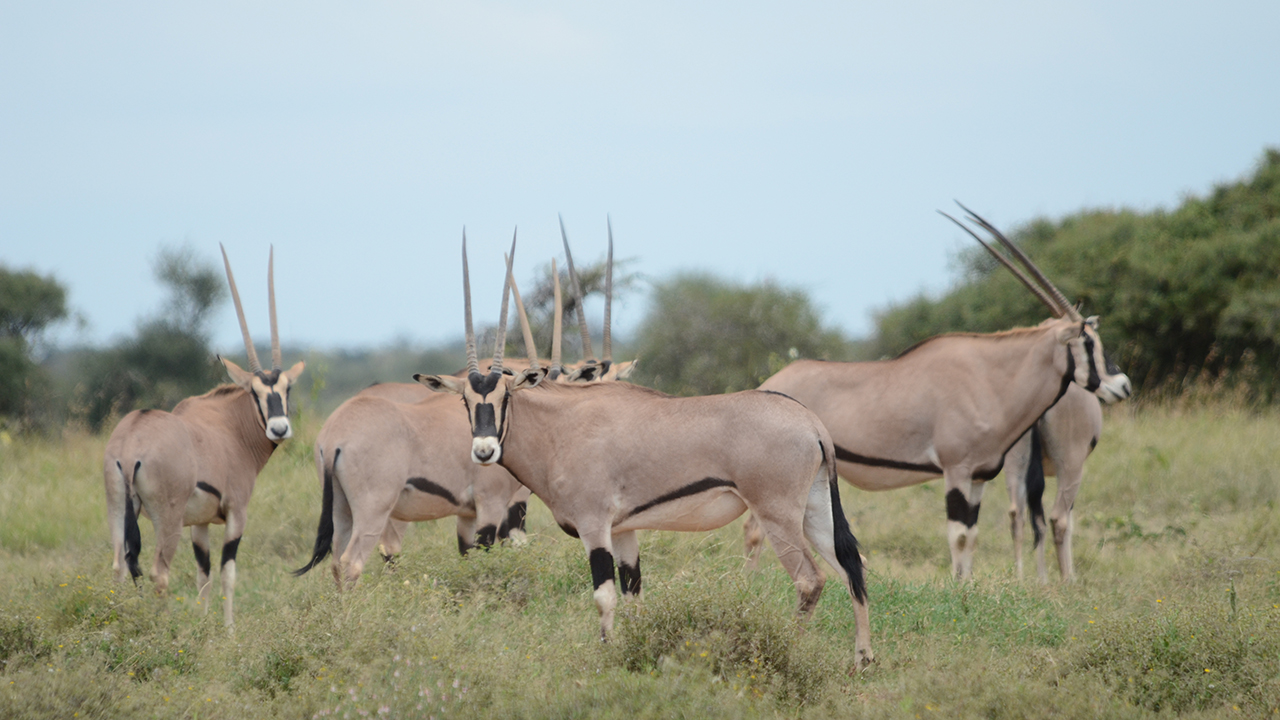
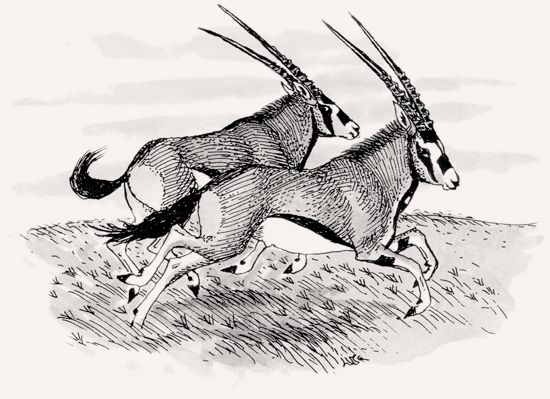
With long, straight horns and stunning face markings, the beisa oryx is unmistakable. Black lines streak across its nose, forehead, and down its cheeks, creating a mask-like appearance over its otherwise white head. Black badges mark its forelegs and chest. These patterns accentuate the oryx’s every movement and gesture and play a role in its complex social behavior.
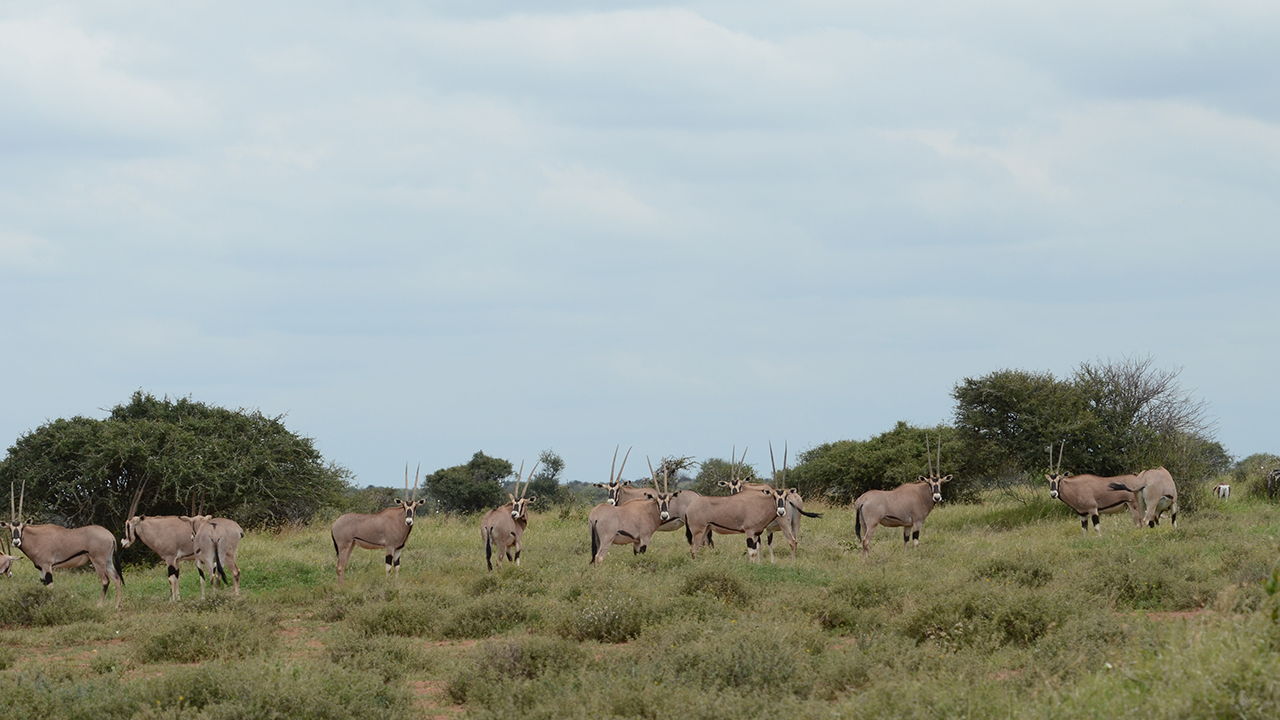
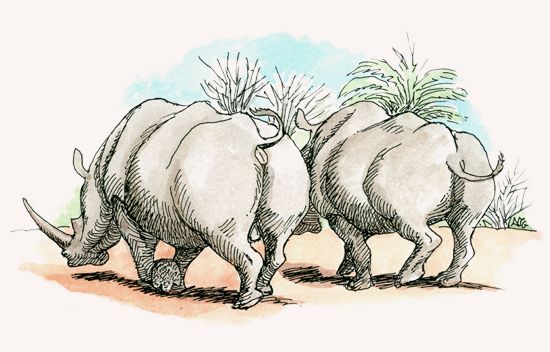
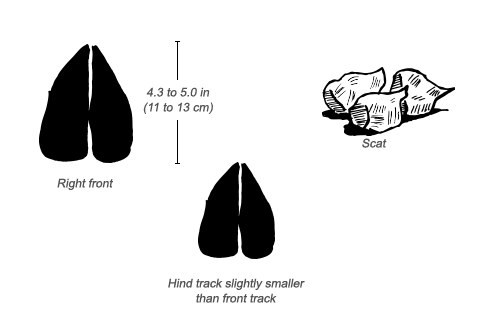
Oryxes typically gather in herds ranging from 20 to 60 individuals, though herds as large as 200 can exist. Females spend most of their time with the herd; males occasionally spend time alone, although the majority stays with the mixed herd. Solitary males develop territories that they maintain by marking the boundaries with a unique defecation pattern. When females enter into a single male’s territory, he uses his body and horns to keep them in the center of his area. However, females will also mate with males in the mixed herd.
Oryxes communicate with one another primarily through displays and gestures, emphasized by this antelope’s distinct coloring. A male conveys dominance with a head nod or an “ear-point” display, where he walks with head and horns held high and slightly turned, and his ears forward. He then twists his horns over to mimic a slow-motion blow in front of his opponent. The subordinate male keeps his head low and horns pressed down, then jumps away when the dominant male delivers his mock blow. Oryxes also use stares and postures to communicate.
During a “tournament” display, an oryx begins to circle the herd, gathering speed until it suddenly shifts to a high-stepping stride with neck pulled back and chin up. The oryx then shakes its head from side to side, in precise opposition to its running stride. The display ends when the oryx slows down and charges into the center of the herd, either pretending to slam into another individual or actually clashing horns. If the oryx chooses the latter behavior, it quickly dashes away from the attacked individual to end the conflict. Then it either returns to circling the herd or charges another member. Others in the herd often join the running individual, and oryxes of all ages quickly become bound up in the excitement of the “tournament.”
Beisa oryxes have declined dramatically in many areas across their range, due in part to hunting for their meat and hides and to their competition with livestock for food. These antelopes remain common in regions where livestock numbers are low. Only 17 percent of the total oryx population resides in protected areas.
The beisa oryx is a grazer and enjoys feeding on a wide variety of grass species. During the dry season, they will partake in browsing and are even known to eat the poisonous adenium plant. Oryx feed at times of the day when plants hold the most water.
A male oryx courts a female before mating with her. This courtship begins with an extensive circling of one another. If a female oryx does not want to mate, she may charge at the male or lie down in order to discourage him (though a male will try to encourage a reclined female by nudging her until she gets up). If the female is receptive, however, the circling escalates into a slow figure-eight or circular pattern led by the female. The actual process of mating is very short and quick. Oryx have a gestation period of 255 to 259 days and can give birth throughout the year. When a female is about to calve, she isolates herself from the herd. After birth, the calf hides for the first two to three weeks, during which time the female may rejoin her herd.
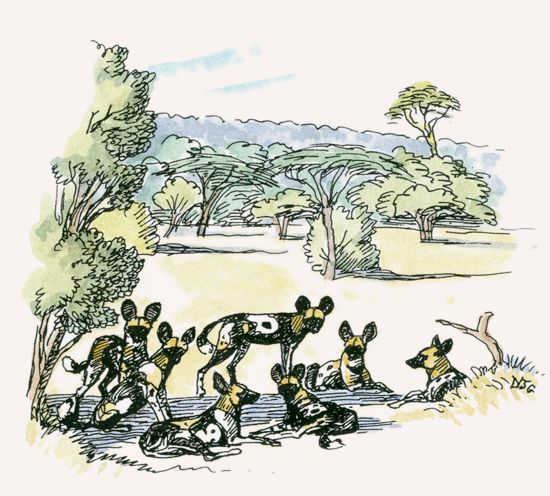
Although oryx are prey to many large predators, including lions, leopards, and cheetahs, they are well-equipped to protect themselves. A herd of oryxes was observed confronting a pack of attacking African wild dogs by forming a semi-circle. When the dogs approached, the largest adult male oryx lunged forward, forcing the dogs to retreat.
Although the beisa oryx once inhabited a large region throughout northeastern Africa, from Sudan to Ethiopia and down to Tanzania, its range has shrunk dramatically. It remains common in Ethiopia and northern Kenya.
Beisa oryx live in arid and semiarid regions, especially bushland and grassland. Oryx herds move based on the condition of the habitat. In the wet season, they move to high ground, away from tall grass and saturated areas. They will move great distances to find a satisfactory habitat. If an area is particularly suitable, they may stay for a few seasons.
An estimated 50,000 beisa oryxes are sparsely distributed across their range. In northern Kenya, the Samburu District saw a 50 percent decrease in oryx numbers from the mid-1990s to 2008, though Laikipia has maintained a stable population.