
Lessons Within This Unit
Print this Page
Sign up for our Interactive Classroom – Coming Soon!
Additional Resources
Earth’s Ecosystems
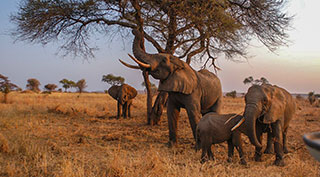
Earth is comprised of many ecosystems—tropical rainforests, grasslands and savannas, and tundra to name just a few. In the dry lands of Africa, the most common ecosystem is the savanna, or tropical grassland. Grasses are sustained by rainfall, and they support many species of herbivores, such as zebras, antelope, buffalo, rhinos, elephants, and many domesticated livestock species. The wildlife, in turn, supports predators, such as lions, hyenas, cheetahs, and leopards. In this unit, we will explore
- how grasses are constructed and how animals use the different parts.
- how grasses grow and what environmental factors affect their growth.
- who eats the grasses and how the cycle of life is organized into food chains and food webs.
- how wildlife and domesticated grazers who eat the same foods can coexist with sustainable management and conservation.
Lessons Within This Unit
Unit 5: How Ecosystems Work
Lesson 1 of 6
Lesson 1: Grass Parts
Students examine the role of grasses in the foundation of an ecosystem through both the inside structures that enable grass to survive and its interactions with outside life.
2 weeks
Unit 5: How Ecosystems Work
Lesson 2 of 6
Lesson 2: Grass Growth
Students will delve further into grasses by learning how they grow and respond to animals, weather, fire, and other influences.
4 weeks
Unit 5: How Ecosystems Work
Lesson 3 of 6
Lesson 3: Who Lives in an Ecosystem?
Students will understand how all animals in an ecosystem are adapted to specific roles and live connected in complex food chains and food webs. Folk tales sometimes provide insights into animal adaptations.
2 weeks
Unit 5: How Ecosystems Work
Lesson 4 of 6
Lesson 4: Food Chains
Students will further understand how organisms are linked in food chains and food webs, playing the roles of producers, consumers, and decomposers, and learning how energy is transferred along the chain.
2 weeks
Unit 5: How Ecosystems Work
Lesson 5 of 6
Lesson 5: Competition Between Wild and Domestic Animals
Students will learn how human interference through the domestication of plants and animals can have positive and negative effects on an ecosytem.
2 weeks
Unit 5: How Ecosystems Work
Lesson 6 of 6
Lesson 6: Indigenous Knowledge
Students will learn the value of using local resources to understand how land use has changed over time and and how this has affected the community.
2 weeks