
Objectives
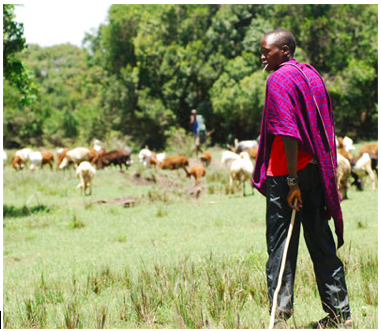
- Students will learn how livestock and wildlife compete/co-exist.
Background
One of the major threats to animals, particularly the Grevy’s zebra, is competition with livestock for resources. It can be beneficial to protect both the livestock and the wildlife, as wildlife can also generate income, through tourism, for the community. Some communities, like Kalama in the Samburu district or Koija and Il Motiak in the Laikipia district, have designated wildlife and livestock areas to help preserve both sources of income.
Materials
- Sticks and rocks
Vocabulary
- Herbivore: an organism that eats mostly plants
- Predator: an animal that lives by killing and eating other animals
- Producer: an organism, usually a plant, that converts sunlight energy into living material; usually the first step on the food chain or food web or first trophic level of a food pyramid
Preparation
Draw a large circle in the dirt (not too big; they need room to move but feel cramped when all of the children are in the circle).
Procedure
Students will play a game. Divide into two teams. Scatter the sticks and rocks. Allow the first team to run into the circle and gather sticks for 30 seconds. Count the sticks. Scatter the sticks again and allow the second team to gather the rocks for 30 seconds. Count the rocks. Now, scatter the rocks and allow both teams into the circle for 30 seconds to gather their sticks or rocks. It is okay to gather the other team’s objects to keep them from winning, but you only score points for you own objects. Count each team’s objects at the end. (Do not count the objects they kept from the other team.)
Play one more round where you block off a portion of the circle from one team. Draw a line and tell them they can’t cross there to gather their items. Make it smaller than the other team’s area so it is unfair.
Discussion: The rocks and sticks represent different resources that animals need to survive. In some cases, animals need different resources to survive and in others, they both need the same resource (water). How does livestock affect wildlife and its chance to survive?
Possible Questions
- Who won the game and why?
- Should everyone be given a fair chance?
- How did it feel when you gathered your objects with only your team and then when the other team was gathering at the same time?
- What if this was the way we got our food and some people couldn’t get enough?
- How are Grevy’s zebra affected by livestock in our area?
- What does this activity teach us about wildlife and livestock and how they compete for food?
- How do humans help (or hinder) wildlife from getting what they need to survive? How does this affect the animals and the environment?
- Is there enough food and water for livestock and wildlife? How does drought affect this?
Extensions
1. COMPARE THE PAST AND THE PRESENT
Discuss with elders their views about the competition and co-existence between livestock and wildlife. How have their views changed or stayed the same over time? Is raising livestock different now than in years past? Is there more competition for resources now than in the past? How does livestock affect the behaviors of wildlife? How does wildlife affect raising livestock?
2. WHO EATS THE GRASS?
Students make a segmented drawing of a blade of grass. Next to each of three segments (low, medium, high) they draw the type of herbivore that eats down to that level (gazelle, oryx, Grevy’s zebra). Students make cuts in the paper so that each herbivore can be folded over the part of the grass they eat. Discussion: How can different savanna herbivores co-exist? What would happen if there was a drought? A migration?
Add domestic animals (cows, goats, sheep). Now what happens?
Alternative
Have students make a list of animals that are present when livestock is near and a list of those that move away when livestock approaches.
Allow children to act out a typical scenario of what might happen when wildlife and livestock meet. Break the students into small groups and have them act this out, then explain the role of each animal and why they think the animals responded the way they did.
Possible Questions
- Are there animals that need to be kept away from livestock?
- How do predators affect livestock?
- Describe reasons why animals might behave a certain way when the other group is present.
Alternative
Read students the Story of Stripe, by Belinda Low (see Worksheet 1: Stripe’s Story), the young Grevy’s zebra who learns the hard way the impact that humans have on its ability to survive and reproduce. Since the story stops without an ending, have students provide endings. They should also go home and discuss the story with their parents and grandparents. When they return to the club, discuss the different types of endings the children provide and how they may differ from those provided by other members of the family or community.
3. ENDANGERED SPECIES
Objective
Students will understand that there are a variety of reasons why species are endangered and that different explanations apply to different species.
Background
Primary causes of endangered species of Laikipia (from MpalaLive! website):
Grevy’s Zebra – habitat loss, competition
- Competition with livestock for grass
- There is a higher concentration of Grevy’s zebras in Laikipia because they have been pushed out of northern areas.
Vulture – poison
- Livestock carcasses are poisoned in order to kill lions, but the vultures also eat the carcasses leading to a decline in population.
Hartebeest – habitat loss, competition
- Hartebeest compete with cattle for habitat and food.
Wild Dogs – human conflict, habitat loss
- Vehicle accidents, guns, snares, and poison all kill wild dogs.
- Prey shortages
Leopard – poaching, human conflict
- Leopards risk being killed by ranchers when they kill livestock.
- Poached for their skins
Reticulated Giraffe – habitat loss
- Habitat fragmentation
- Occasionally poached
Cheetah – habitat loss
- Contrary to common belief, cheetahs are not normally poached.
- Habitat encroachment by humans
- Declining number of prey
African Buffalo – habitat loss, overgrazing, poaching
- Overgrazing by livestock
- Habitat fragmentation
- Buffalo are considered dangerous and therefore are considered a hunting prize.
- Buffalo are susceptible to rinderpest.
Lion – habitat loss, human conflict
- Habitat degradation and less prey
- Ranchers poison livestock carcasses in order to kill lions.
Hippo – habitat loss
- Drought, damning of rivers, and pollution all affect hippo habitat.
- Hippos are susceptible to rinderpest.
- Occasionally poached
Black and White Rhino – poaching, habitat loss
- Both types of rhinos are poached for their horns.
- Habitat destruction has also played a role.
African Elephant – habitat loss, poaching
- Retaliation killing is also a cause.
Materials
- Poster board
- Tape
Vocabulary
- Endangered species: a species whose dwindling population numbers have caused it to be classified as being threatened with extinction
- Habitat loss: the destruction or disappearance of the natural environment an animal or plant species requires to survive
- Retaliation killing: taking the life of an animal out of revenge for some act it did against humans, such as killing livestock or a person
- Overgrazing: intense eating of vegetation over long periods that allows no time for the plants to recover
Procedure
- Explain the concept of endangered species. Make sure the students understand that the term “endangered species” is not the same as a “dangerous species.” Ask students for examples of endangered species.
- Ask students to think of reasons why a species may be endangered. Write the answers on the board and fill in any gaps.
- In each corner of the room hang a poster that states a different reason a species may be endangered (“Habitat Loss,” “Poaching,” “Human Conflict,” “Other”). These four categories should include the different ideas that the students come up with. Make sure that the students understand into which category more specific reasons go (overgrazing, deforestation etc.). It is possible that one explanation could fit into two categories. The most common animals are listed in the background section but this list can be expanded upon.
- State an endangered animal and the students should run to the corner of the room that they think explains why that animal is endangered. Choose one student from each group and have them explain why they decided to stand in that corner. After each group has gone, state and explain the correct answer.
- At the end of the lesson ask the students to write one thing they learned in their notebooks.
4. MORE OR LESS GAME
This game has been adapted from the website www.PopulationEducation.org.
Objective
Students will understand that a growing population affects resources and the environment.
Background
Kenyan population has increased by over 5 times since 1960, from 8 to 43 million in 2012. This has had a serious impact on the environment.
Materials
- 3 sets of cards in 3 different colors; 1 set in one color says MORE; another set in another color says LESS; the third set in a third color with the following words: PEOPLE, RHINOS, HABITAT, GRASS, TREES, LIVESTOCK, DEFORESTATION, EDUCATION, CONSERVATION, TOURISM, SOIL EROSION, MANYATTAS, POACHING, ROADS, ELEPHANTS, WATER.
- A set of arrows
- Masking tape
Procedure
- Tape a column of MORE cards on the board or wall, a column of LESS cards, and a third column of the third set of words.
- Tell the students, “As we’ve seen in the Web of Life game, everything is connected to everything else. As the population of Kenya has increased, this affects resources and our environment. Today we’ll play a game that looks at the connection between them.”
- Begin making a word web by putting the words “MORE PEOPLE” on the board. Ask students, “If there are more people, what might we have more or less of?”
- A student in invited to come up and choose a MORE or LESS card and another word to go with it, such as MORE HOUSES. Use an arrow to connect the two phrases. The student must explain the connection.
- Have students continue to build a word web and discuss.
Discussion
Point out that there are many correct answers to this activity. Remind students that connections can be positive, negative, or neutral.
See if the students can think of any other words to add.