
Big Ideas
- Wind is air in motion caused by changes in pressure.
- Wind is a method for transferring energy.
Essential Questions
- Where does wind come from?
- How can humans use wind to their advantage?
Content Outcomes Addressed
- Students will be able to describe the process by which wind is created.
- Students will be able to explain how wind affects the motion of objects.
- Students will be able to cite examples and explain how wind can be used by humans.
Standards Addressed
NGSS:
- Disciplinary Core Ideas: ESS2.A (K-2) (6-8) PS2.A (K-2) (3-5), PS2.B (K-2) (3-5), PS3.A (3-5) (6-8), PS3.C (K-2), PS3.D (K-2)
- Science and Engineering Practices: 1, 2, 3, 6
- Crosscutting Concepts: 2, 3, 4, 5, 7
CCSS: ELA/Literacy:
- Reading: R.K.1, R.1.1, R.1.4, R.1.10, R.2.4, R.3.1, R.4.1, R.4.2, R.5.1, R.5.2
- Writing: W.K.2, W.1.2
- Speaking and Listening: SL.K.3, SL.K.5, SL.K.6, SL.1.3, SL.1.5, SL.1.6, SL.2.3, SL.2.6, SL.3.3, SL.3.6, SL.4.3, SL.5.3
National Geography Standards: 7, 15
Background
Wind is air in motion. It is caused by the uneven heating of Earth’s surface by the sun. Since the surface is made of very different types of land and water, it absorbs the sun’s heat at different rates.

During the day, the air above the land heats up more quickly than the air over water. The warm air over the land expands and rises, and the heavier, cooler air rushes in to take its place, creating winds. At night, the winds are reversed because the air cools more rapidly over land than over water.
In the same way, the large atmospheric winds that circle Earth are created because the land near the Equator is heated more by the sun than is the land near the North and South Poles.
Wind is called a renewable energy source because the wind will blow as long as the sun shines.
Over 5,000 years ago, the ancient Egyptians used wind to sail ships on the Nile River. Later, people built windmills to grind wheat and other grains. The earliest known windmills were in Persia (Iran). These early windmills looked like large paddle wheels. Centuries later, the people of Holland improved the basic design of the windmill. They gave it propeller-type blades, still made with sails. Holland is famous for its windmills.
American colonists used windmills to grind wheat and corn, to pump water, and to cut wood at sawmills. As late as the 1920s, Americans used small windmills to generate electricity in rural areas that had no electric service. When power lines began to transport electricity to rural areas in the 1930s, localwindmills were used less and less.
Vocabulary
windmill: a machine or device that transforms kinetic energy from the wind into another useful form of energy, such as electricity
air current: moving bodies or streams of air; can be measured on many different scales and can carry considerable force
kinetic energy: the energy of motion; any object with mass and velocity has kinetic energy. K = ½ mv.
Resources
http://www.nrel.gov/learning/re_wind.html
Pre- and Post-Assessment
Assess prior knowledge by asking students to respond in writing and with pictures to the prompt, “Why is wind important for humans and animals?” Have students repeat this activity after the unit of study.
Misconceptions
- Air has no mass.
- Wind “just is.” It’s not created by anything; it always exists.
- Trees make wind by moving their branches.
- People and animals make wind when they move.
- Wind makes air move. (Fact: Wind is moving air.)
Investigation 1: Interacting with the Wind
Focus Question
What affect does thewind have on different objects?
Materials
- A windy day (or a bunch of fans inside a classroom)
- Different objects to be dropped and observed interacting with the wind
- “What is Wind?” chart (print out from Resources, upper right)
Procedure
- Read the following poem to the class, and then ask the students: What was the author’s purpose for writing the poem? (What does the author want you to know?)
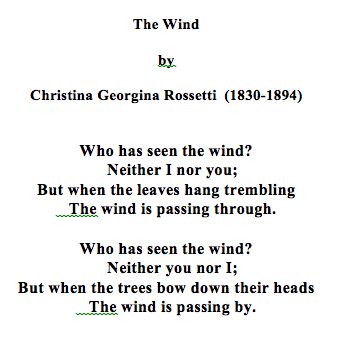
- Have students write down a response to the prompt: “Describe the wind. Can you see wind? Feel it? Smell it? Hear it? Taste it? How do you know it’s there?” Have students use all of their senses to describe wind in their notebooks. If it is a windy day, allow students to go outside. They can use what they already know and anything they observe. What evidence can they provide to support their descriptions of wind?
- Ask the students, “What effect does wind have on different objects?” Ultimately, the students will discover, among other things, that wind can make objects move. It can affect animal behavior and can even break things.
- Show students the collection of items that you brought to class. Have students use these items to fill in the chart What is Wind? (print out from Resources, upper right). In the first column list the item; in the second column, have students make a hypothesis (prediction) of what will happen to each object in the wind; in the third column they will fill in their observations.
- After all objects and predictions are entered, begin testing each item. This may be outside on a windy day, or inside by using fans, having the students blow with their mouths or fan their notebooks. Students should record the effects of wind on each of the objects in the third column of the chart.
Discussion Questions
- Using wind, how far could you make one object go?
- What senses were involved in your observations: sight, hearing, touch, taste, smell?
- What does this experiment tell you about the wind?
- What other examples demonstrate the ability of wind to make things move?
- How would the earth change if there were no wind?
- How do humans use wind?
Extensions
- Have students act out their interpretation of wind without using any words (e.g. soft breezy day, violentwind storm, etc.). Then the class can discuss the good and bad effects of different types of wind on the weather and environment.
- Have students can draw pictures of wind. We really don’t see the wind, just its effects. Each student should represent wind in his/her own way. Share the drawings. See what similarities and differences there are in the various interpretations.
- Have students make pinwheels to see how wind energy can be used to do work. They can compare the pinwheels to windmills that are often used to pump water from the ground. Students can also make weather vanes to see how wind direction changes over time or how variable wind direction is at different places.
- Older students can build a windmill using the directions at http://science.wonderhowto.com/how-to/construct-model-windmill-and-calculate-its-power-259781/
- History of Wind Power Timeline Project: Have students put together a timeline for the use of wind power by humans.
- Break the students into groups and have each group conduct research on the history of human wind energy use. Each group should find ten “events” in the history of wind power. Each event should have a date and brief description about why it is important to the development of wind power.
- Create a timeline stretching around the room that spans from 5000 BCE to the present day. (The timeline should not be to scale, as there will be many more events in the last five centuries than in any time before that.)
- Have students write their “events” on small cards and then place them on the timeline.
Resources for the history of wind power: