
Big Ideas
- Most plants reproduce through pollination, aided by wind or animals.
Essential Questions
- What are the mechanisms that allow pollinating plants to reproduce?
- What is the role of animals in plant pollination?
Content Outcomes Addressed
- Students will develop an understanding of plant parts involved in reproduction.
- Students will understand how plants use the world around them to facilitate pollination.
Standards Addressed
NGSS:
- Disciplinary Core Ideas:LS1.A (K-2), LS1.A (3-5), LS1.B (3-5), LS2.A (K-2), LS3.A (K-2), LS3.A (3-5), LS3.B (K-2), LS3.B (3-5)
- Science and Engineering Practices: 1, 3, 4, 6, 7, 8
- Crosscutting Concepts: 1, 2, 4, 6
CCSS: ELA/Literacy:
- Writing: W.K.7, W.K.8, W.1.7, W.1.8, W.2.7, W.2.8, W.3.8, W.4.8
- Speaking and Listening: SL.K.1, SL.K.3, SL.K.4, SL.K.5, SL.K.6, SL.1.1, SL.1.3, SL.1.4, SL.1.5, SL.1.6, SL.2.1, SL.2.3, SL.2.4, SL.2.6, SL.3.1, SL.3.3, SL.3.4, SL.3.6, SL.4.1, SL.4.3, SL.4.4, SL.4.6, SL.5.1, SL.5.3, SL.5.4, SL.5.6
CCSS: Mathematics:
- Mathematical Practice: MP.3, MP.7
- Measurement & Data: K.MD.B.3, 1.MD.C.4
Background
Plants, like animals, need to reproduce for their species to survive. Roughly 90 percent of plants are flowering plants [http://eol.org/info/449], and thus the most common form of plant reproduction is pollination. Pollen is a fine substance created by the stamen, or male part of a plant. Pollination occurs when pollen comes into contact with the stigma, which is the tip of the pistil, the female part of the plant. This process fertilizes plant seeds. Pollen is often carried from flower to flower by animals such as bees and hummingbirds (called pollinators), or by wind. The color and scent of a flower can attract pollinators.
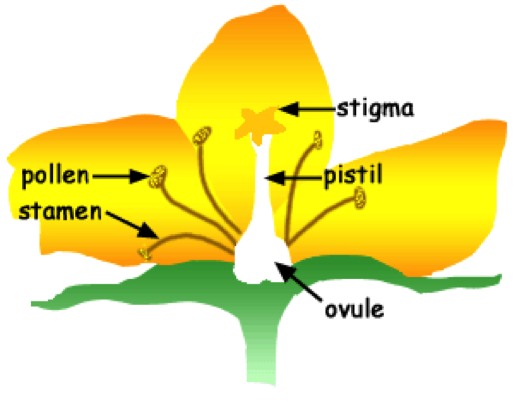 Parts of a Flower
Vocabulary
- pollination: the transfer of pollen from a stamen to a pistil
- pollen: a fine powder produced by certain plants that plays a role in reproduction
- stamen: the (male) part of a flower where pollen is produced
- stigma: the tip of the pistil (the female part of the flower), which receives the male pollen grains
- pistil: the (female) part of the flower that receives the pollen
- ovule: a minute structure that, after fertilization, becomes a plant seed
Pre- and Post-Assessment
Assess prior knowledge by asking students to draw a flower and label its parts. Also ask them about the relationship between bees and flowers. Have students repeat this activity after the unit of study.
Misconceptions
- Plants are asexual.
- Insects intentionally pollinate plants.
Investigation 1: Exploring the Outdoors
Materials
- Notebook and writing utensils
- Eraser
- Flowers (These can be wild or in a garden.)
Procedure
- Ask students what they know about pollination. Brainstorm a list to write on the board. Using the background information above, fill in any blanks.
- Next have the class brainstorm the parts of a flower (again, fill in any blanks as necessary). Make copies of the diagram above or use it to draw the parts of the flower on the board and have students copy it into their notebooks.
- To test understanding, ask for a few volunteers to act as stamens, pollen, a bee, and stigmas. Have them act out pollination.
- Go outside!
- Find plants. Whether or not you have a garden, hopefully they will be out there! With grass it can be difficult to find the flowers. (In fact, not all grasses need to pollinate, but you don’t need to get into that.) Students should find various plants and draw the different flowers, attempting to identify each part.
- If the plants are pollinating, you can demonstrate with a pencil eraser how pollination works. Rub the pistil of one plant, point out the pollen to the students, and then rub the pollen off onto the stigma of another plant (of the same species, of course). Have the students try the same thing.
- Now explain to the students how this would work naturally, in a world without erasers. Insects and hummingbirds (butterflies and hummingbirds are mainly attracted to the bright color; for bees and moths, it is more the sweet scent) come to drink the nectar. If they (unwittingly) rub up against the pistil, pollen can rub off onto them. Then, when they fly off to another flower and (unwittingly again) rub against the stigma, pollination occurs.
- Have the students smell and look at the flowers. Ask what they think makes each plant attractive to pollinators.
- Talk about how some plants are pollinated by wind, not animals. These flowers do not need to be as attractive and generally have longer stamens and pistils that are more exposed to the wind.
End Product/Assessment
Back in the classroom, have students design their own flower. Have them describe in writing how it is pollinated (by an animal, wind, or something creative), and how the flower’s features help in the pollination process.
Extension: Who Pollinates What?
The website http://www.mbgnet.net/bioplants/downloads/pollination.pdf contains, on its first page, an activity called “Create a Flower.” Using construction paper, pipe cleaners, and other craft materials, students can design a flower that might attract a specific pollinator. For more on which pollinators are attracted to which kinds of flowers, check out: http://www.mbgnet.net/bioplants/pollinators.html.
Discussion Questions
Plants existed on Earth for a long time before animals, but since the rise of animals, plants have adapted to make use of them. Other than as pollinators, what are other ways plants use animals (oxygen, Venus fly traps, etc.)? Recall from the previous lesson (Unit 3, Lesson 1) how animals (and humans) use plants (food, shelter, carbon dioxide, etc.).