
Grass Parts
- Students will learn the grass parts and what functions each part serves.
Background
Grassland biomes are large, rolling terrains of grasses, flowers, and herbs. Latitude, soil, and local climates for the most part determine what kinds of plants grow in a particular grassland. A grassland is a region where the average annual precipitation is great enough to support grasses, and in some areas a few trees. Therefore, grasses are essential to the survival of all creatures living there. Different parts of the grasses help plants survive and thrive.
Materials
- Tools to dig up grasses
- Notebooks
Vocabulary
- Biomes: a major regional or global biotic community, such as a grassland or desert, characterized chiefly by the dominant forms of plant life and the prevailing climate
Preparation
Prepare your own sketch of grass, labeling the following parts: Blade, Culm, Rhizome, Roots, Stolon, and Flower.
Procedure
Students will carefully dig up a small section of grass, shake off as much dirt as possible, and draw a sketch of the grass in their notebooks. Then using their labeled sketch, students should label the parts of the grass they dug up.
While there are many grass parts, let’s stick to just a few.
Blade: the long floppy leaves that stick out the sides of the stem
Culm: the main stem of the grass; it carries water from the roots to the blade where food is made.
Rhizome: a sideways underground stem that produces roots and shoots
Roots: the underground parts of the plant that take in water and nutrients; roots also anchor the plant.
Stolon: a sideways stem, above the ground, that produces roots and shoots
Flower: the part of the plant where reproduction takes place; sometimes they look like small leaves.
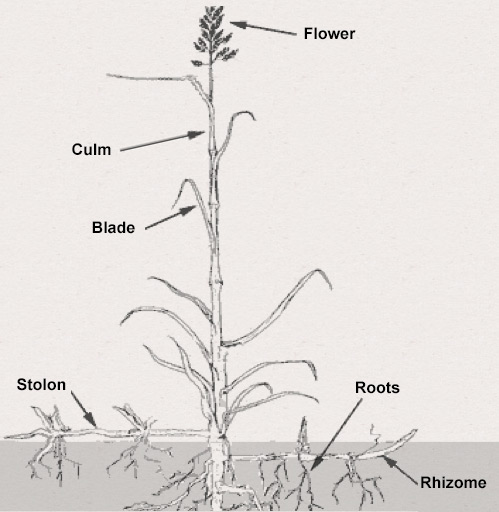 Grass Parts
Discussion
Each part of the grass serves a function and allows the grass to survive and reproduce. This is important because grass serves many functions. It helps keep the land from erosion and provides food for many creatures.
Possible Questions
- What would happen to the environment if there were no grass (wind/rain erosion)?
- How would the loss of grasses affect the animals? (They would need to move to another place or die without food.)
- What if grass was missing one of its parts? The stem? The flower? The rhizomes?
Alternative
Find grasses that are safe for humans to eat. Wash these carefully with water. Allow students to chew, then spit out the different parts. Discuss which teeth were used for tearing and chewing. Discuss which parts would make better food and why.