Field Guide
Genetta maculata
Blotched Genet
Swahili: Genet, Kanu, Kala


- Type
- Mammal
- Daily Rhythm
- Nocturnal
- Diet
- Omnivorous
- Life Span
- In the wild: Insufficient data In captivity: Up to 10 years
- Conservation Status
- Lower risk
- Weight
- Male: 3 to 7 lb (1.4 to 3.2 kg) Female: 3.0 to 5.5 lb (1.3 to 2.5 kg)
- Size
- Male: 33 to 34 in (85 to 108 cm) long, including tail Female: 33 to 42 inches (83 to 106 cm) long, including tail
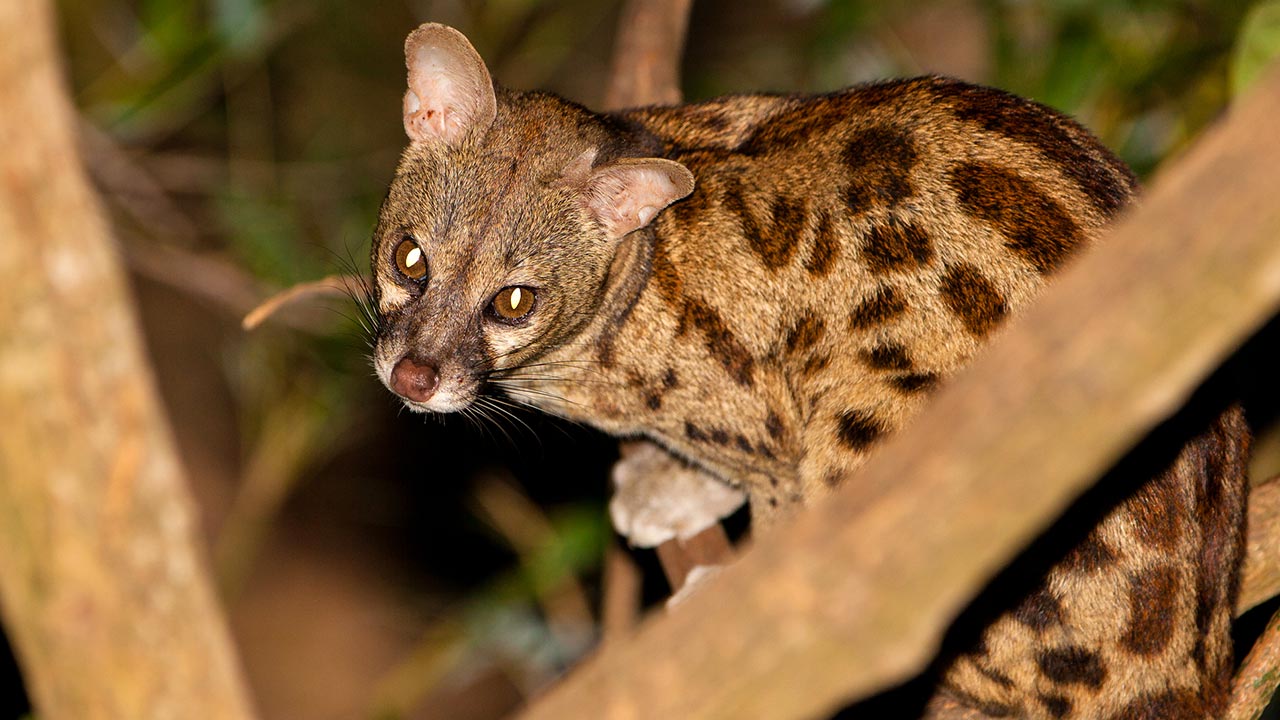
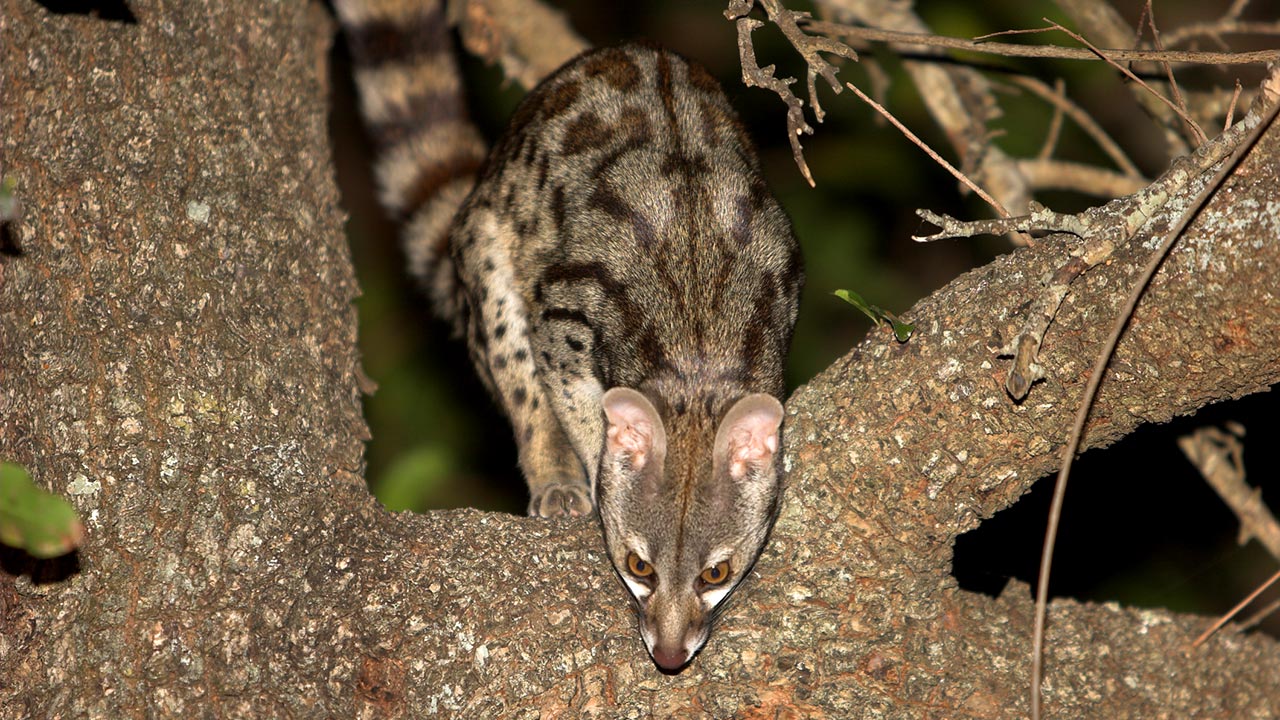
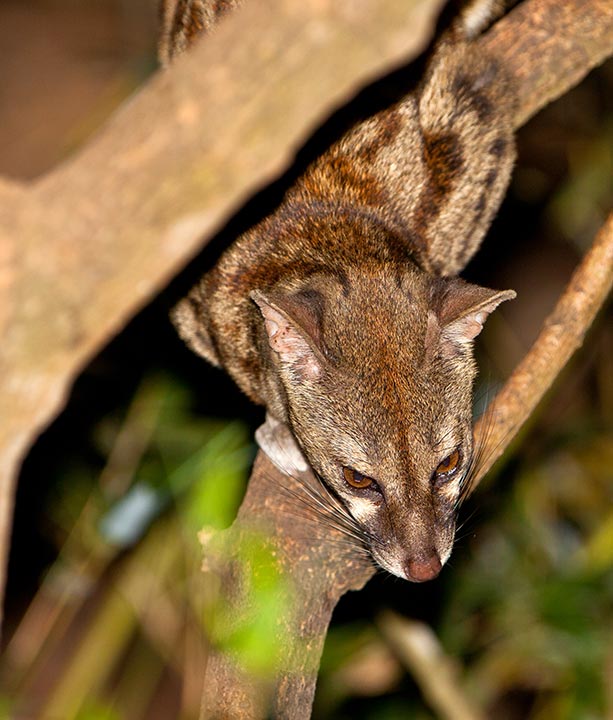
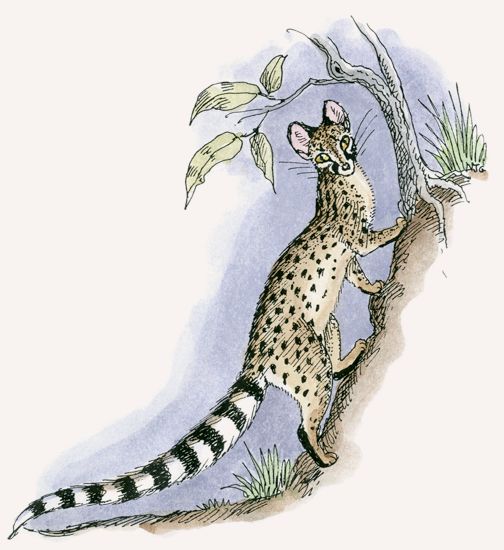
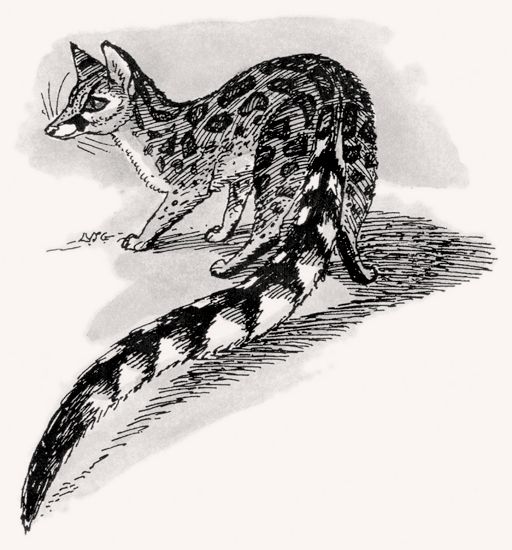
The blotched or large-spotted genet varies dramatically in body size, coat pattern, and coloration across the regions where it lives—and even among individuals. Arboreal carnivores, blotched genets typically have black facial masks accented by white spots under the eyes and on the muzzle. Its chocolate brown spots are ringed with black and vary in shape and size. Dark bands radiating off a central stripe decorate their tails, which are sometimes as long as their bodies!
Blotched genets are solitary creatures except during breeding season when a male and female may be found together. They are also territorial. Females inhabit 62-acre (25-ha) ranges, while male ranges can be 1,235 acres (500 ha) and include several female ranges.
Blotched genets have not been observed to use a complex communication system. They mark their territories with secretions, urine, and feces. During courtship, a male blotched genet “grumbles” as he follows a female.
The blotched genet forages at night and is most active between sunset and midnight. During the day, they escape the heat by resting in enclosed shelters, such as in trees, hollow logs, tree roots, burrows, rocks, or man-made structures.
Although the blotched genet is labeled as a poultry thief and hunted for bush meat, the population is only declining in some areas. Their broad, diverse range across Africa makes them less vulnerable to population plunges.
Blotched genets will eat whatever they can catch, though rodents make up most of their food. Their diet also includes other small mammals, terrestrial and aquatic slugs and snails, mollusks, centipedes and millipedes, spiders, scorpions, insects, crustaceans, fish, amphibians, reptiles, small birds, and eggs. The blotched genet stalks its prey and then pounces, delivering several bites to make the kill. It supplements its diet with vegetable matter, and fruits, seeds, and berries are important foods in some regions.
The breeding peaks of blotched genets vary across their vast range. In Kenya, this genet has two breeding peaks: October to December and March to May. Following a gestation period of 70 to 77 days, females give birth in protected spots, such as hollow trees, leafy nests, or under man-made structures. The kittens are born blind and covered with hair that has a distinctive blotched pattern. At ten days, they open their eyes; at four weeks, their canine teeth emerge; and at approximately six weeks, they start eating solid food.
Previous Next
Blotched genets live only in Africa. They range west from Ghana to Eritrea and Somalia, living as far north as the Sudanian-Sahelian savannas and as far south as central Namibia and eastern South Africa.
Blotched genets thrive in a variety of habitats, including rain forests, swamp zones, rivers, woodlands, moist forests, savanna-forest mosaics, thickets, and grassy savannas. They prefer open areas close to water and a covered habitat, and are common in cultivated areas.
The blotched genet must protect itself from aerial and terrestrial predators, which include large cats, spotted hyenas, eagles, and eagle owls.
The blotched genet population is difficult to estimate due to the evasive and nocturnal behavior of these animals.